
Unley heritage tiling area directory
Use this Unley area directory to find locality-specific heritage tiling guidance. Unley sits close to Adelaide's CBD and includes established residential streets where the relationship between a home's frontage, verandah, path and street edge can be an important part of its presentation. For a tessellated tile project, the right starting point is the property itself: its surviving fabric, proportions, access, drainage and the character of the surrounding setting. We provide design consultation, tessellated tile supply, installation, restoration and coordination of stone bullnose or edging details for projects across Unley.
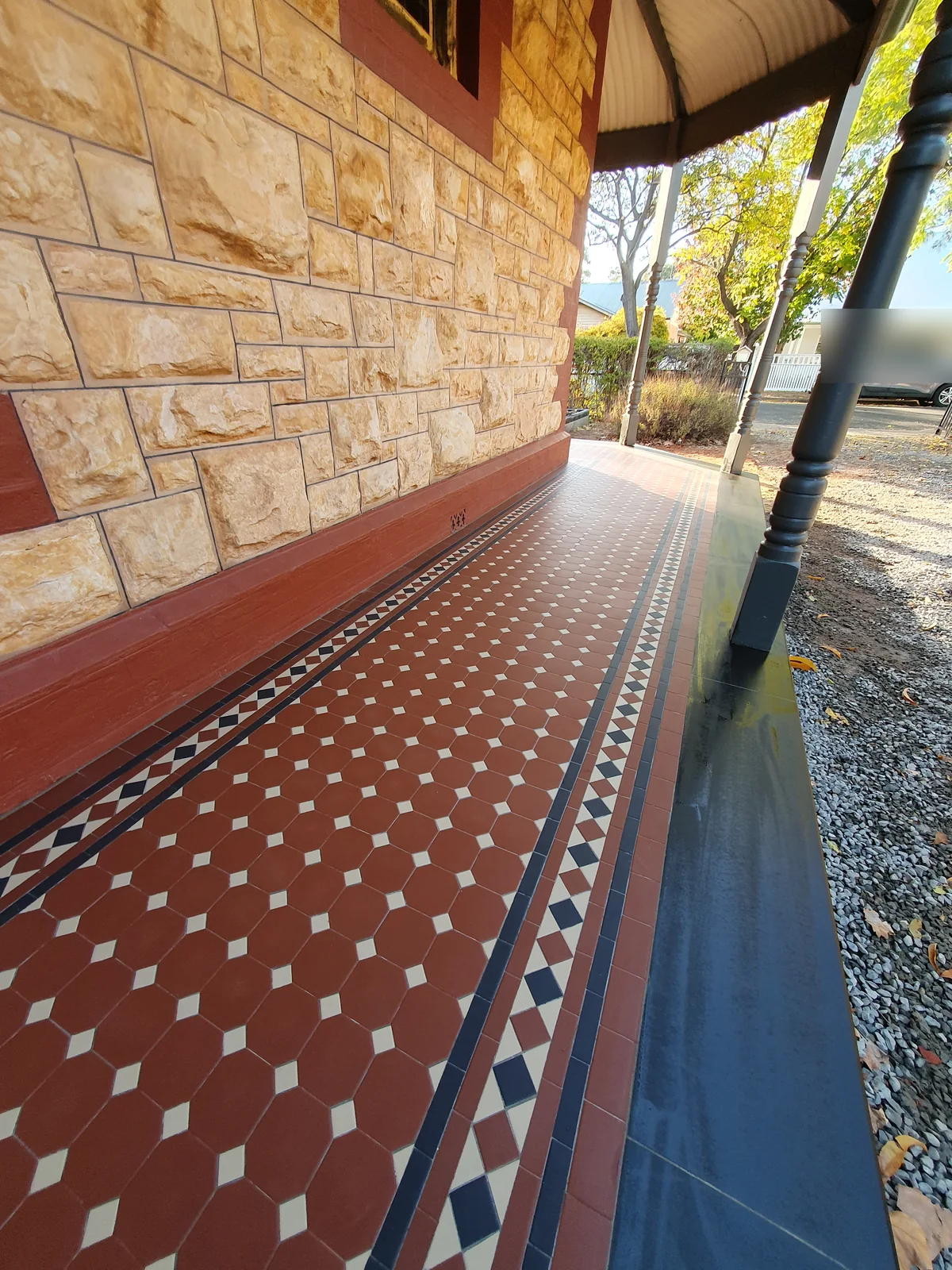
Read the house before choosing the pattern
The City of Unley's heritage and character guide describes a local residential vocabulary that includes verandahs, masonry such as bluestone or sandstone, timber joinery, period roof forms and complementary fencing. Those details can help set the scale and tone of a new tiled path or verandah, but they should be read as property and streetscape clues rather than a template for every home.
A design consultation can consider how a tessellated layout meets the front steps, verandah posts, garden edge and threshold. On an older property, a restrained border, a rhythm that follows the frontage and an appropriate transition at the door can be more convincing than an isolated pattern chosen without regard to the existing architecture. Where stone bullnose or another edging treatment is needed, the edge can be considered as part of the whole entrance composition.
Appreciating Heritage and Character Dwellings — City of Unley Design Guide 1
Design cues across Unley's period homes
The council guide records a range of Victorian, turn-of-the-century and inter-war dwelling types rather than one uniform Unley style. It refers to simple and more substantial Victorian cottages and villas, later decorative roof and verandah treatments, and inter-war homes with broader roof forms, masonry elements and terracotta tile use. These observations can inform colour, scale and border decisions when they are genuinely present at the property.
For a replacement or new installation, the practical brief is to coordinate the tile field with the home's existing lines and materials. For restoration, the priority may instead be to document what remains, identify sound tiles, and decide where careful repair or selective replacement is more appropriate than removing original work. The suitable balance depends on condition and the intended use of the space.
Appreciating Heritage and Character Dwellings — City of Unley Design Guide 1
Check the property before building or altering
Heritage and character controls are not determined by a suburb name alone. PlanSA distinguishes Local Heritage Places, Historic Areas, Character Areas and Representative Buildings, and SAPPA provides an address-based way to inspect planning zones and overlays. A property-specific check is worthwhile before finalising a design or starting external work.
The City of Unley advises that approval is required in most cases before development work, and that listed heritage items can have additional requirements for external and sometimes internal alterations. Use the council and PlanSA guidance to establish the applicable pathway. Our role is to coordinate the tile design and work with the existing property information; we do not represent a heritage authority or provide statutory approval.
Heritage and character | PlanSASouth Australian property and planning atlas — PlanSADevelopment Application process — City of Unley
Plan the work around the way the space is used
Front verandahs and paths need more than a pleasing pattern. The brief should consider the approach to the house, thresholds, step edges, weather exposure, drainage, access for installation and how the finished surface will meet adjoining materials. Existing tiles or stone should be assessed before decisions are made about removal, repair or a new matching field.
We can help develop a considered design, coordinate tessellated tile supply, install new work, restore suitable existing surfaces and coordinate stone bullnose or edging requirements. The final selection should follow the property's evidence and the practical conditions on site rather than assume that a period label dictates one pattern or material.
Appreciating Heritage and Character Dwellings — City of Unley Design Guide 1Development Application process — City of Unley
Explore local Unley service areas
The Unley service directory also connects local guidance for Unley, Unley Park, Parkside, Goodwood, Wayville, Hyde Park, Malvern, Millswood, Myrtle Bank, Fullarton, Highgate, Black Forest, Clarence Park and Kings Park.
For broader Adelaide heritage-service navigation, see the existing Adelaide heritage tiles hub and restoration service pages. Those routes provide the wider city context; this Unley page keeps the practical focus on properties and streetscapes in the City of Unley service area.
Unley area directory
Your Heritage Tiling Questions
Are all homes in Unley heritage listed?
No conclusion about an individual home should be drawn from the suburb or council name alone. South Australian planning guidance distinguishes several heritage and character categories, and SAPPA can be used to check the property's mapped zones and overlays. The applicable status should be confirmed for the specific address.
Do I need approval for new verandah or pathway tiles in Unley?
The City of Unley says approval is required in most cases before development work, including constructing, adding to or altering a building, and notes additional requirements can apply to listed heritage items. Check the current PlanSA and council pathway for the property before work begins; the answer depends on the proposal and applicable controls.
How can a tessellated pattern suit an older Unley house?
Begin with the house's existing proportions and details. The City of Unley guide points to features such as verandahs, masonry, timber joinery, roof forms and fencing across several period housing types. A layout can then be developed around the frontage, steps, thresholds and adjoining materials instead of selecting a pattern in isolation.
Can existing tessellated tiles be restored rather than replaced?
That depends on the condition and extent of the surviving work. A site assessment can identify sound tiles, damaged areas, movement, edge conditions and transitions before deciding between selective restoration, coordinated replacement or a new installation. The appropriate approach is property-specific.
Where can I check Unley's planning or heritage overlays?
PlanSA's South Australian Property and Planning Atlas is a free map-based tool. Search the property address, open the planning layers and inspect the zones and overlays that apply. The City of Unley also directs property owners to SAPPA and PlanSA when checking zoning and development requirements.
Discuss Your Heritage Tiling Project
Share your location, project details and photographs using our enquiry form, or call 0433 932 711.