
Tessellated tiles and heritage tiling in Millswood
Millswood's established streets, period homes and documented historic-area character create a setting where a tiled verandah, entrance or pathway should be designed around the property rather than treated as an isolated pattern. We can assist with design consultation, tessellated tile supply, installation, restoration and stone bullnose or edging coordination for Millswood and the surrounding Adelaide area, subject to the condition and requirements of the individual site.
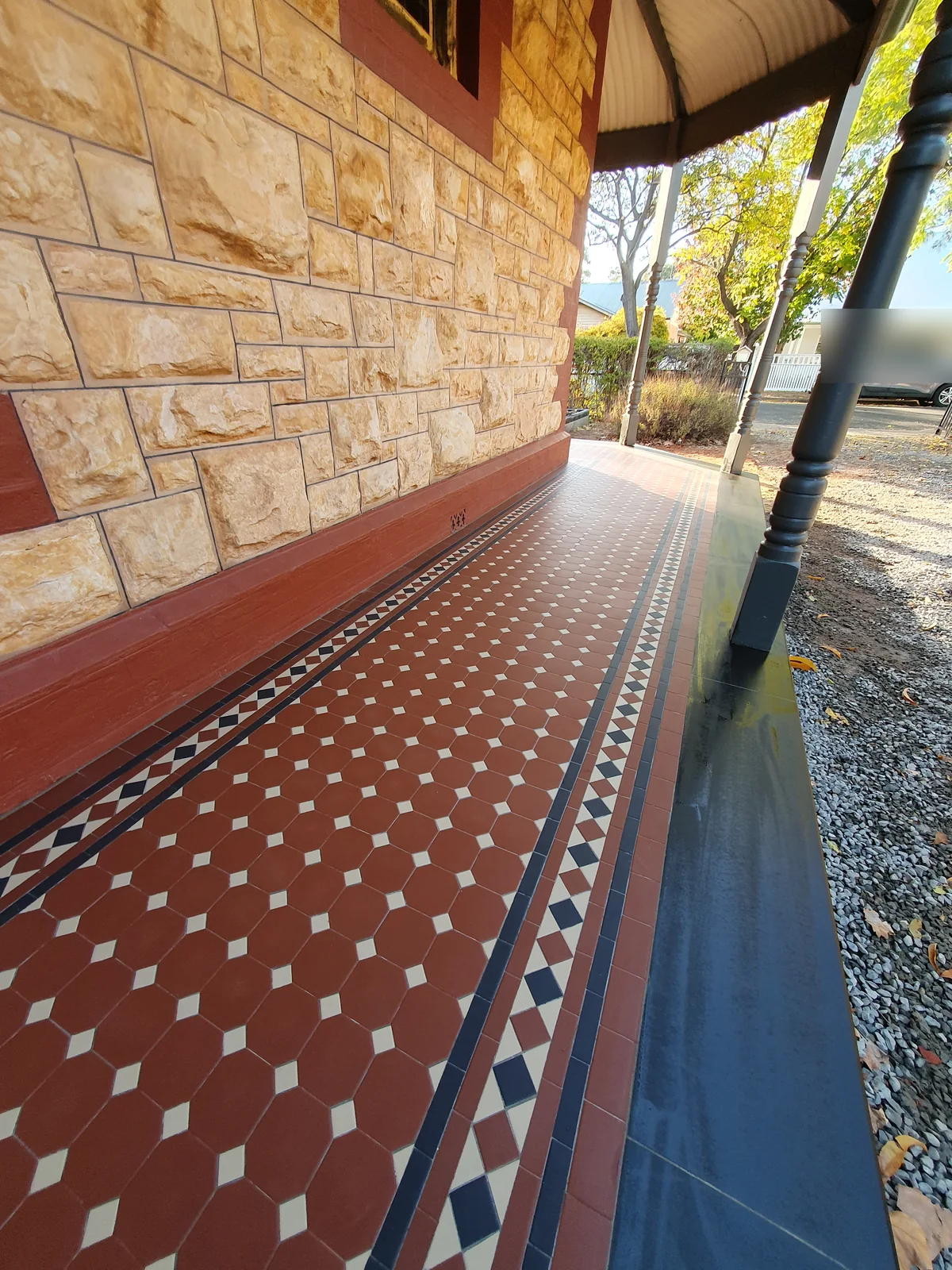
A planned residential setting with layered period character
The City of Unley heritage study records Millswood's 1882 layout, a further 1926 subdivision and the 1917 Millswood Estate subdivision that brought substantial housing development by the early 1920s. That history helps explain why the locality can contain related but not identical residential settings, with the particular street, allotment and building carrying much of the design information.
For a tiled frontage, look first at the house's proportions, verandah depth, steps, threshold and relationship to the front garden or fence. The repeat, border and edge should sit comfortably with those existing elements instead of assuming that one period pattern suits every Millswood property.
Working with verandahs, roofs and open streetscapes
The Residential Spacious Millswood (South) Historic Area Statement identifies Victorian and turn-of-the-century cottages and villas alongside inter-war housing, including bungalow, Tudor and art deco expressions. It also refers to hipped and gable roofs, chimneys, open verandahs, decorative plasterwork, ironwork, timberwork and lattice. These features make scale, colour balance and the junction between tile and existing masonry important design questions.
The same statement describes generous allotments, wide streets, wide verges, large street trees and generally open front fencing. A new or restored tiled path can therefore be considered as part of the frontage and its arrival sequence, including how edging, levels and transitions read from the street.
Respecting the material palette and surviving fabric
Millswood's historic-area guidance names sandstone, bluestone, brick, stucco, rendered masonry and timber joinery among the local material and detail characteristics, with corrugated iron and tiled roofs also represented. For a verandah or path, the tile field and border can be developed with attention to the existing brickwork, stone, render, steps and door thresholds rather than selected independently.
For restoration, begin by documenting what survives: loose or missing tiles, earlier repairs, the original layout if it remains legible, movement at edges and the way water moves across the frontage. The appropriate response depends on the actual substrate and existing fabric; there is no universal repair or installation recipe.
Check the property before changing older tilework
Millswood's area-wide historic character does not mean every dwelling is individually heritage-listed. The South Australian Heritage Places Database records individual places and advises owners to confirm current implications with Heritage South Australia and the Planning and Design Code or council. Check the particular address and proposed scope before removing, replacing or extending older tilework, steps, edging or related fabric.
AHTC can discuss design, supply, installation and restoration options, but this page is not a planning approval or heritage endorsement. Property-specific requirements should be confirmed with the relevant authority before work begins.
Your Heritage Tiling Questions
Are all Millswood homes heritage-listed?
No. Millswood has documented historic-area character and individual heritage places, but those facts do not make every dwelling individually listed. Check the particular property through the South Australian Heritage Places Database and the current Planning and Design Code or council information.
What should I consider when choosing tessellated tiles for a Millswood verandah?
Consider the verandah depth, frontage width, steps, threshold, fence line, existing brick or stone and how the pattern will be seen from the street. Millswood's documented character includes open verandahs, generous allotments and open front fencing, so proportion and clean transitions are especially useful starting points.
Can older tessellated tiles in Millswood be restored rather than replaced?
Restoration can be considered after the surviving tiles, layout, edges, substrate and movement have been assessed. The appropriate choice depends on the condition of the particular surface and any heritage or planning requirements; retention, repair and replacement should not be assumed in advance.
Does a Millswood historic area automatically require approval for tile work?
No single approval answer applies to every address or scope. Historic-area and individual heritage controls are property- and work-specific. Check the current Planning and Design Code and council or Heritage South Australia guidance before starting work.
Discuss Your Heritage Tiling Project
Share your location, project details and photographs using our enquiry form, or call 0433 932 711.