
Salisbury heritage tiling area directory
Use this Salisbury area directory to find locality-specific heritage tiling guidance. Salisbury brings together an established township, later residential growth and a broad northern Adelaide landscape. From the Little Para River origins of Salisbury township to the post-war expansion recorded by the City of Salisbury, properties across the area can call for different tile decisions. We can help with design consultation, tessellated tile supply, installation, restoration and stone bullnose or edging coordination for verandahs, paths, entrances and other considered transitions.
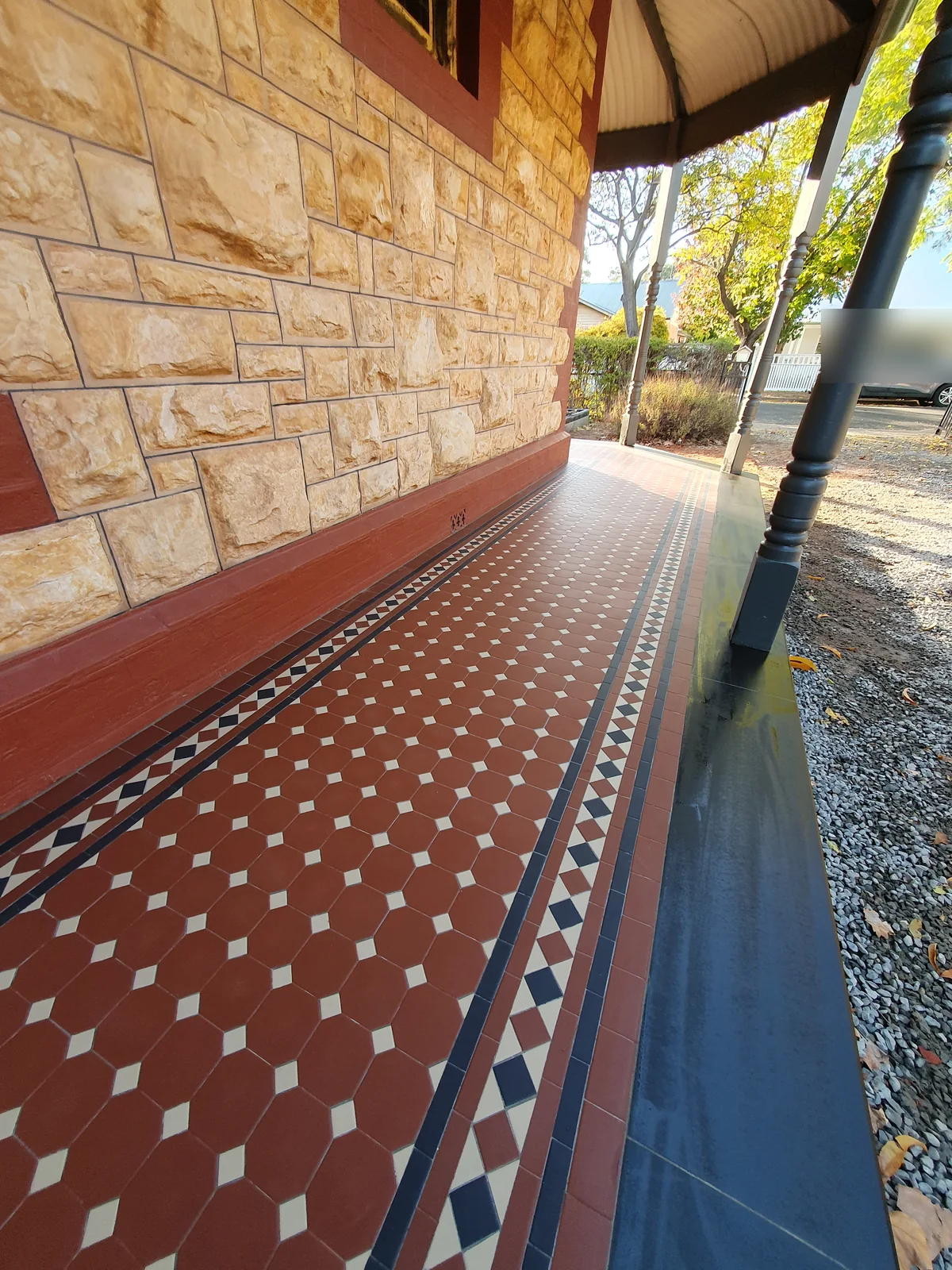
A varied northern Adelaide setting
The City of Salisbury sits about 25 kilometres north of Adelaide and reaches from Gulf St Vincent to the Para Escarpment and the foothills of the Mount Lofty Ranges.
Salisbury township has documented nineteenth-century history, while the council also records rapid wartime and post-war growth. That makes it useful to begin with the building itself: consider its entry proportions, verandah lines, existing paving and the relationship between older fabric and later additions before selecting a pattern or border.
Quick facts — City of SalisburyOur History — City of Salisbury
Designing around existing character
The council's local history material identifies historic places around Salisbury, including St Augustine's Roman Catholic Church, the Salisbury Police Station and Courthouse, St John's Anglican Church and Salisbury Institute. These places provide local design inspiration through their civic and ecclesiastical scale, but they should not be treated as a template for every home in Salisbury or its surrounding localities.
For a period-influenced verandah or entrance, useful questions include whether a new tessellated field should echo an existing threshold, how a border will meet steps and walls, and whether stone bullnose or another edging treatment will give the work a clear finish. Where original tiles remain, restoration and careful matching may be more appropriate than replacing the whole surface.
Plan the work for the property
Salisbury's geography includes coastal plain, waterways and foothill edges, and the council documents Greenfields Wetlands as a major constructed water-management and landscape project. For a home, that is a reminder to review levels, thresholds, falls, drainage interfaces and exposure during design and installation rather than relying on a standard layout or substrate assumption.
If a property or its setting may be heritage listed, check the South Australian Heritage Places Database and the Planning and Design Code before work begins. Heritage status is not a blanket description of Salisbury homes, and the relevant controls depend on the individual place and proposed work.
Quick facts — City of SalisburyGreenfields Wetlands — City of SalisburyAltering heritage listed properties — South Australian GovernmentSA Heritage Places Database Search
Salisbury area directory
Your Heritage Tiling Questions
Does every property in Salisbury have heritage protection?
No. Salisbury includes many different development periods and property types. Heritage controls apply to particular listed places, areas or objects and can also consider the setting of a State Heritage Place. Check the individual property through the South Australian Heritage Places Database, the Planning and Design Code and the relevant authority before making assumptions.
Can a new tessellated pattern suit a Salisbury period home?
It can, when the design responds to the building. Start with the existing entry or verandah proportions, nearby paving, stair geometry and any surviving tile evidence. A restrained field with a considered border may sit more comfortably than an oversized pattern, but the right choice depends on the property and the intended use.
Should original tiles be restored or replaced?
That depends on their condition, extent and significance. Document the existing surface first, then compare selective restoration and matching with replacement. If the property is listed or may affect a listed place's setting, obtain property-specific heritage guidance before altering the work.
What should be considered for an outdoor tiled path or verandah?
Review levels, thresholds, drainage interfaces, exposure, access and how the pattern will finish against steps, walls and edging. These decisions should be made from the site and the existing building, not from a universal substrate or layout recipe.
Discuss Your Heritage Tiling Project
Share your location, project details and photographs using our enquiry form, or call 0433 932 711.