
Tessellated tiles in Salisbury Heights
For Salisbury Heights homes, a tessellated floor, verandah or pathway can be planned as a considered part of the property's architecture rather than an isolated surface. AHTC can help with design consultation, tessellated tile supply, installation and restoration, including coordination of stone bullnose or edging where it suits the setting. Salisbury Heights sits within the City of Salisbury in Adelaide's northern suburbs, so the right approach is guided by the property, its exposure and its existing details rather than by a generic suburb-wide style.
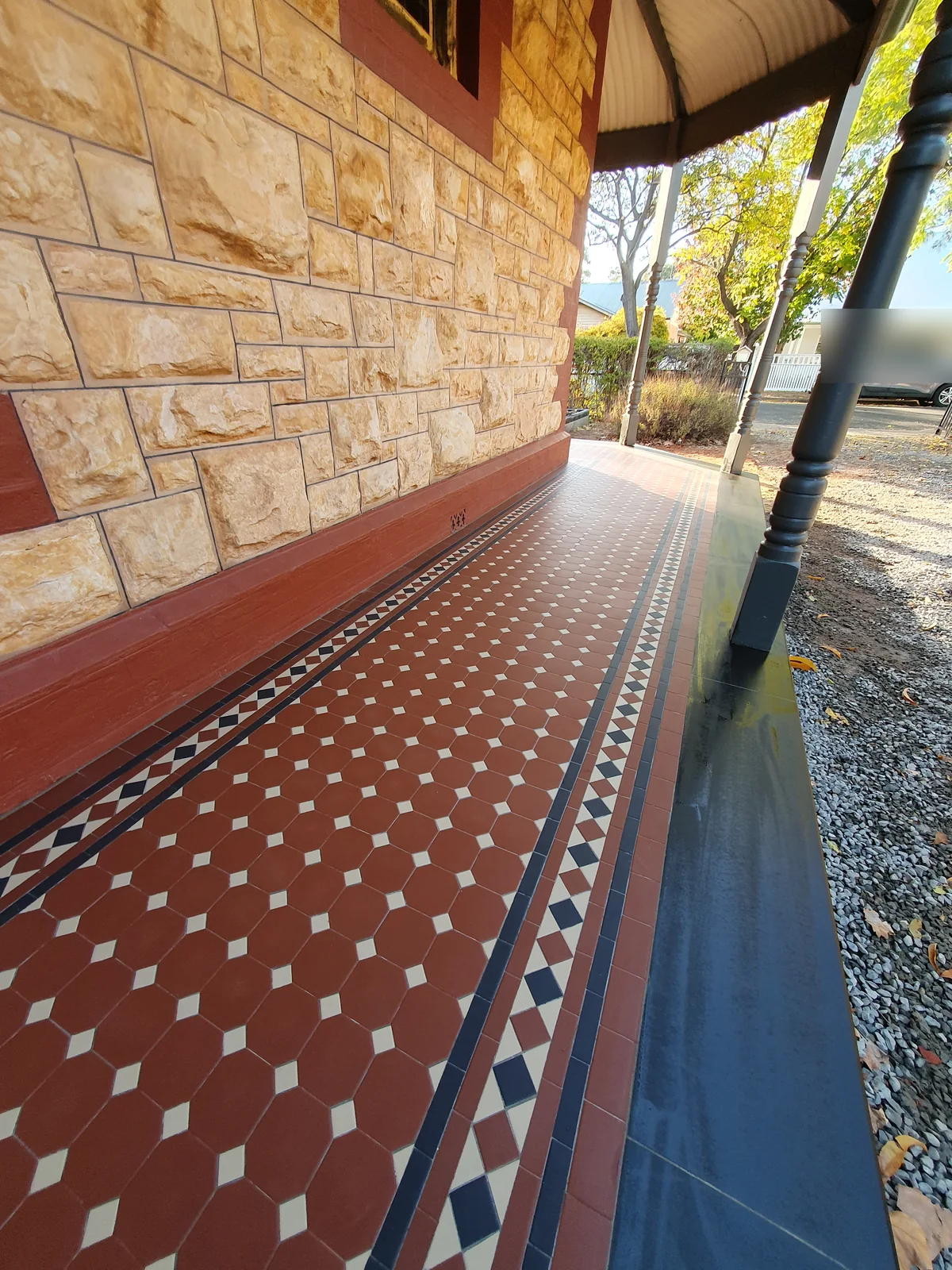
A Salisbury Heights setting for careful tile design
The City of Salisbury extends north of Adelaide towards the Para Escarpment and the foothills of the Mount Lofty Ranges. That broader setting can bring different relationships between entries, verandahs, paths and garden edges, so proportions and transitions should be considered on site. A restrained border, a clearly framed threshold or a pattern that follows the geometry of an existing porch may be more successful than treating every project as a new decorative floor.
The Salisbury area also has a longer local history, from Kaurna cultural connections and the early Salisbury township through to substantial post-war expansion. That history is useful context, but it does not make every Salisbury Heights property heritage housing. Design choices should respond to the actual building and its surviving details.
Quick facts — City of SalisburyOur History — City of Salisbury
Check the property before changing original fabric
The South Australian Heritage Register records individual State Heritage Places in Salisbury Heights. A listing is a property-specific fact, not a description of every home in the suburb. Before removing an older tiled surface, altering a listed place or working near a heritage place, check the relevant property information and current planning controls for the site.
Where existing tiles remain, assessment should begin with what can be retained: pattern, edge detail, levels, cracking, drainage and the relationship to adjacent stone or masonry. New work can then be designed to sit comfortably with the building without presenting an unverified period style as original.
Protecting Heritage and Character Policies in the Planning and Design Code
Plan verandahs, entries and pathways as one composition
For a front path or verandah, the useful decisions are practical as well as visual: how the pattern meets steps, where borders turn, how the surface transitions to adjoining paving, and how water is managed at exposed edges. A measured layout helps avoid awkward cuts at thresholds and keeps the main geometry legible from the approach.
For restoration, matching is not just a matter of choosing similar colours. Existing dimensions, wear, bond, border sequence and the condition of the base all affect the result. Supply and installation can be coordinated with the design consultation, while stone bullnose or edging details can be considered where the project calls for a defined edge.
Protecting Heritage and Character Policies in the Planning and Design Code
Your Heritage Tiling Questions
Does every Salisbury Heights home have heritage protection?
No. The South Australian Heritage Register identifies particular listed places, and planning controls can also vary through mapped heritage or character overlays. Check the specific property before assuming that a suburb-wide rule applies.
Can existing tessellated tiles in Salisbury Heights be restored rather than replaced?
Often the first question is what can be retained. The pattern, tile dimensions, edge details, condition and the supporting surface should be assessed before choosing selective repair, careful matching or replacement. A site-led assessment is more reliable than assuming one method suits every floor.
Are tessellated tiles suitable for a Salisbury Heights verandah or pathway?
They can be, provided the design and installation respond to the entry geometry, exposure, drainage, thresholds and adjoining surfaces. Border turns and step transitions should be resolved before ordering or laying the pattern.
Should I check planning information before changing tiles at a listed property?
Yes. South Australian guidance recommends checking the Planning and Design Code and the relevant mapped heritage information for the address or suburb. If the property or its setting is affected by a heritage control, obtain the appropriate property-specific advice before altering original fabric.
Discuss Your Heritage Tiling Project
Share your location, project details and photographs using our enquiry form, or call 0433 932 711.