
Tessellated Tiles in Salisbury North
Salisbury North is a northern Adelaide suburb within the City of Salisbury, with a substantial post-war housing history shaped by South Australian Housing Trust development from 1949. If you are planning tessellated tiles for an established entry, verandah or pathway, the right approach depends on the property's existing fabric, proportions, access and intended use. AHTC can help with design consultation, tessellated tile supply, installation, restoration and stone bullnose or edging coordination for work in Salisbury North.
A post-war Salisbury North setting
The Salisbury Heritage Survey records the start of South Australian Housing Trust construction at Salisbury North in 1949. It notes contracts for 534 dwellings and identifies the first homes as completed on Waterloo Corner Road in July 1950. That history is useful when considering an established property's entry sequence, porch proportions and later alterations, but it does not mean every home in the suburb has the same design or heritage status.
The local setting has continued to evolve. The City of Salisbury records Adams Oval as a Housing Trust-developed sporting precinct from the 1960s and lists tree-lined reserve paths such as Andrews Street Reserve. For tile work, those surroundings are a reminder to consider how a new or repaired threshold meets garden edges, paths, drainage and everyday movement rather than choosing a pattern in isolation.
Designing tiles for an established home
Start with the building that is actually there. Useful checks include the scale of the front elevation, the width and fall of the existing path, the relationship between a verandah and its steps, and whether original tiles or other finishes remain. A restrained border or a carefully proportioned field can sit more comfortably with a modest post-war frontage than a pattern selected only from a catalogue image.
Where existing tiles survive, photographs and site observations can help distinguish a repair-and-match brief from a new installation. Colour variation, worn edges, uneven levels and previous patching should be recorded before layout decisions are made. A property-specific heritage or planning check may also be appropriate where a place has an individual listing or sits within a controlled area; local history alone does not establish that status.
Entries, verandahs and pathways
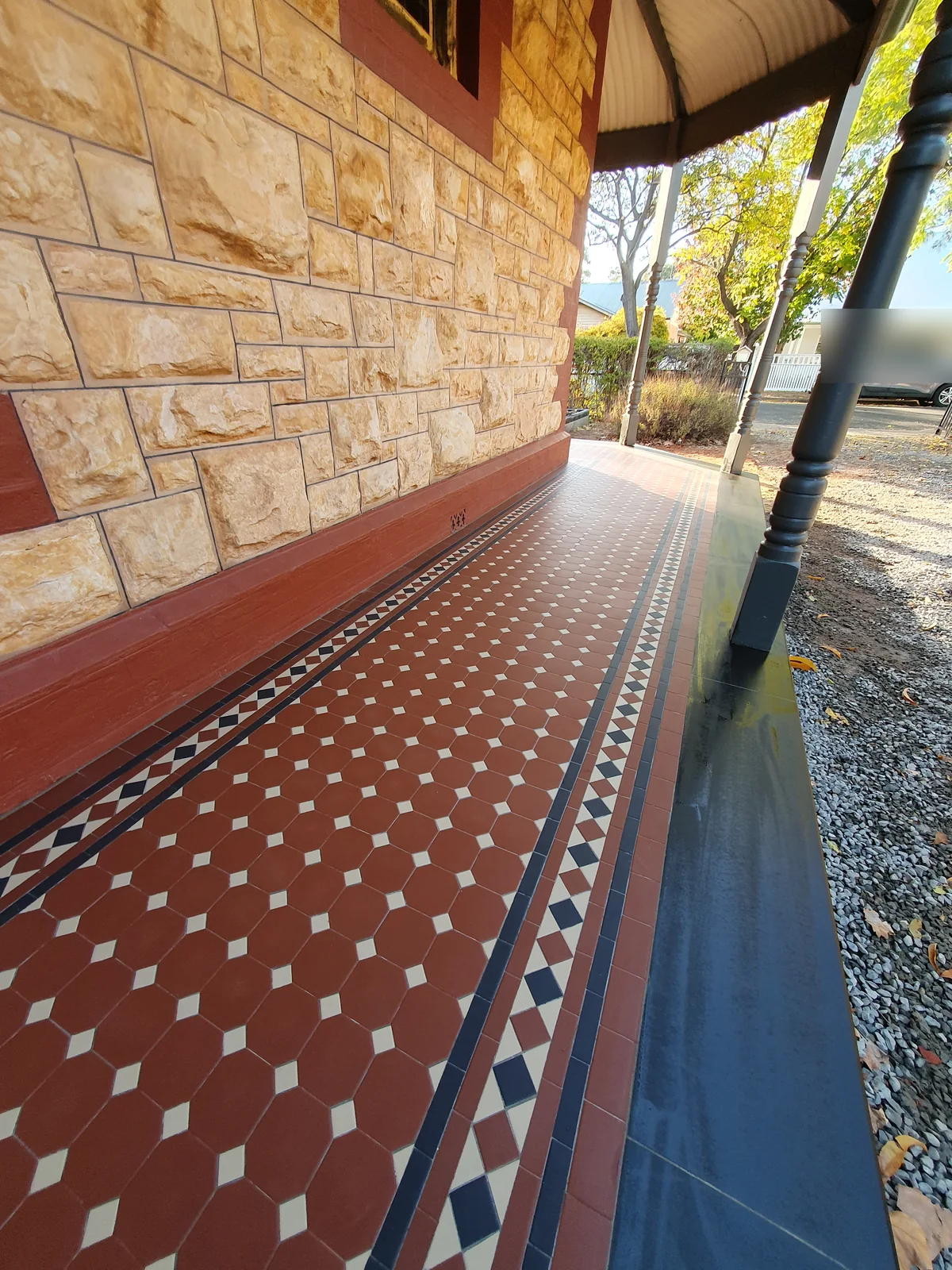
Salisbury North tile projects can involve a front step, porch, verandah, side path or a connected sequence between the street and the door. Each setting needs its own layout review. Check thresholds, step nosings, door clearances, falls and transitions before confirming the pattern, and coordinate stone bullnose or edging where the design calls for a defined perimeter or stair edge.
For an exposed path, the practical brief includes weather, drainage, garden interfaces and the way people approach the entry. For a sheltered verandah, the emphasis may shift to proportion, matching and the relationship between the tile field and existing posts or masonry. Installation details should follow the assessed site rather than a universal recipe.
Restoration, matching or a new layout
A restoration brief begins with the condition of the existing surface: loose or cracked pieces, missing sections, failed edges, moisture, movement and changes made by earlier repairs. The goal may be selective retention and matching, or it may be a new compatible treatment where the original finish cannot be retained. Those choices are made from the property's evidence, not from the suburb name alone.
For a new tessellated layout, design consultation can resolve scale, repeat, border treatment and the transition to adjacent paving or stone. For restoration, tile supply and installation need to be coordinated with the condition assessment and the practical limits of available matching material.
Planning a Salisbury North tile project
A useful enquiry can include the suburb, a few clear photographs, approximate dimensions and whether the request is for a new design, repair, restoration or matching work. It also helps to note steps, access constraints, existing edging and any known property-specific heritage information. This gives the design and installation discussion a practical starting point without assuming the outcome before the site is understood.
Your Heritage Tiling Questions
Does Salisbury North have one consistent heritage architectural style?
No. The suburb has a documented post-war Housing Trust development history, including construction from 1949, but that does not establish one uniform architectural style or heritage status for every property. Tile design should be based on the individual home and any verified property-specific controls.
Can tessellated tiles suit a Salisbury North verandah or front path?
They can, where the proportions, levels, drainage, access and existing materials are suitable. A design review should consider the whole route from the boundary or garden edge to the entry, including steps, thresholds and any stone bullnose or edging.
Should an existing tiled entry be restored or replaced?
That depends on what survives and its condition. Record loose, cracked or missing tiles, edge failures, movement and moisture before deciding whether selective repair and matching, broader restoration or a new layout is the most appropriate response.
Does a Salisbury North address automatically require heritage approval for tiling?
No automatic conclusion should be drawn from the suburb name or its post-war history. If the property is individually listed, within a heritage area or otherwise subject to a planning control, check the applicable current requirements for that property before work begins.
What should I send when asking about tessellated tiles in Salisbury North?
Share the suburb, clear photographs of the existing area, approximate dimensions and whether you want a new installation, repair, restoration or a matching design. Include photographs of steps, edges and transitions where they are part of the work.
Discuss Your Heritage Tiling Project
Share your location, project details and photographs using our enquiry form, or call 0433 932 711.