
Holdfast Bay heritage tiling area directory
Use this Holdfast Bay area directory to find locality-specific heritage tiling guidance. Holdfast Bay brings together coastal Adelaide suburbs including Glenelg, Brighton, Hove, Seacliff, Somerton Park and Kingston Park. Its built character reflects long-established seaside settlements, changing housing patterns and a council-wide heritage program. Authentic Heritage Tiling Co can help with tessellated tile design, supply, installation and restoration, with the approach shaped around the property, the existing fabric and the intended use of the space.
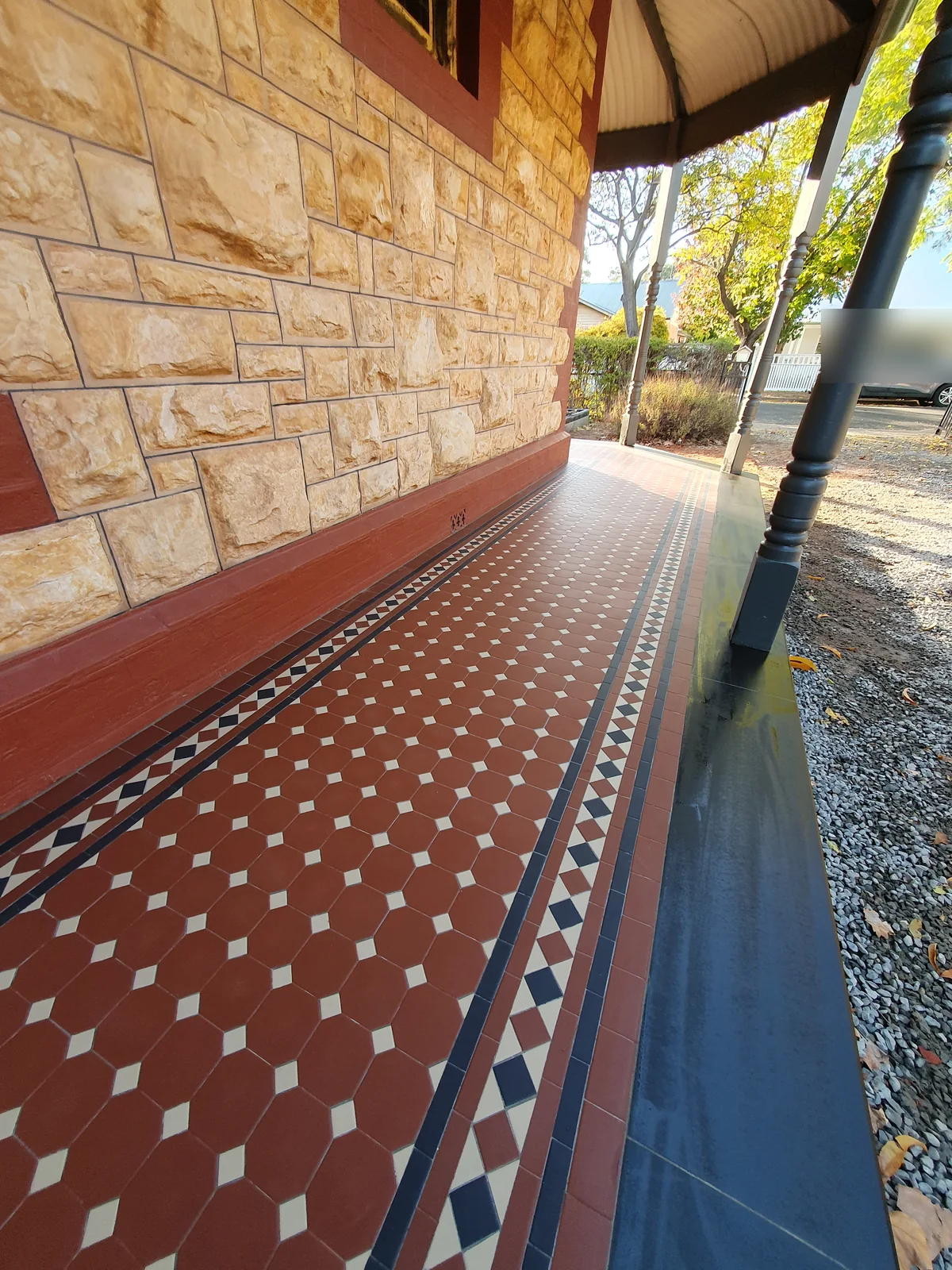
A coastal setting with varied built character
The City of Holdfast Bay grew from the former Brighton and Glenelg councils. Council history records early coastal settlement, holiday houses, railway growth and the development of Brighton as a seaside resort, while Glenelg became a major shopping and visitor centre. That history is a useful starting point for design conversations, but it does not make every house a heritage property or prescribe one pattern for the whole council area.
For a verandah, entry or garden path, the most useful design cues are the proportions of the existing building, the threshold sequence and the relationship between the new work and the street. A restrained border, a carefully scaled repeat or a sympathetic tonal palette can support the architecture without making a new surface look falsely old. On exposed coastal sites, the brief should also consider water management, salt-laden air, cleaning and the transition between tiled and untiled surfaces.
Our History — City of Holdfast BayCity of Holdfast Bay — Local Councils of South Australia
Check the property before changing existing fabric
Holdfast Bay's Built Heritage Action Plan records 30 State Heritage Places and 238 Local Heritage Places across the council area and aims to protect and enhance built-form heritage. Those figures describe the council area as a whole; they do not establish a listing for an individual address.
Before removing original tiles, changing a historic verandah or altering a front path, check the South Australian Heritage Places Database and the current Planning and Design Code information for the property. If a listing or Historic Area Overlay applies, obtain the relevant planning and heritage advice before work begins. Tile design and installation advice can then be coordinated with the property's documented constraints rather than guessing from its suburb name.
Built Heritage Action Plan 2026–2031 — City of Holdfast BaySA Heritage Register and Surveys — Heritage South AustraliaHeritage and character | PlanSA
Design decisions for verandahs, entries and paths
A good tessellated layout starts with the building and the way people approach it. We can discuss the relationship between field tiles, borders, corners, steps and thresholds, then develop a scheme that suits the available width and the visual weight of the façade. For an existing floor, the first question is whether sound original fabric can be retained and integrated rather than replaced unnecessarily.
Installation and restoration require different decisions. New work calls for a clear layout, suitable preparation and considered edge details. Restoration calls for careful inspection, identification of salvageable tiles, selective repairs and a realistic treatment of areas where matching material is unavailable. Stone bullnose or edging coordination can help resolve exposed steps and transitions where it is appropriate to the design.
Holdfast Bay area directory
Your Heritage Tiling Questions
Does every home in Holdfast Bay have heritage protection?
No. The council-wide heritage figures do not mean every home or street is listed. Check the individual property in the South Australian Heritage Places Database and the applicable Planning and Design Code information before changing existing fabric.
Should I restore original tessellated tiles or replace them?
Begin with an assessment of the existing tiles, bedding, edges and drainage. Where original fabric is sound, retention and selective repair may better preserve the character of the space. Replacement may be appropriate where the surface is beyond practical repair or where a new layout is being designed, but the choice should follow the property's condition and any heritage controls.
Could a tiled verandah or path need planning advice in Holdfast Bay?
It can depend on the property, the work and the applicable planning controls. A heritage listing or Historic Area Overlay may affect how alterations are assessed. Check the current South Australian planning information and seek the relevant heritage advice before starting work; a tiling service cannot grant planning approval.
Can a new tessellated pattern suit a coastal Holdfast Bay home?
Yes, when the scheme is designed around the building rather than copied from a generic pattern. Proportions, border scale, thresholds, edge protection, water management and the exposure of the site should all be considered alongside the desired period reference.
Discuss Your Heritage Tiling Project
Share your location, project details and photographs using our enquiry form, or call 0433 932 711.