
Campbelltown heritage tiling area directory
Use this Campbelltown area directory to find locality-specific heritage tiling guidance. Campbelltown sits in Adelaide's inner eastern suburbs, where local history, creek corridors and surviving buildings create useful context for careful tile decisions. This service directory connects Campbelltown with the existing locality routes for Athelstone, Hectorville, Magill, Newton, Paradise, Rostrevor and Tranmere, while recognising that the directory is a service grouping rather than a statement of legal council boundaries. Authentic Heritage Tiling Co can help with design consultation, tessellated tile supply, installation, restoration and stone bullnose or edging coordination.
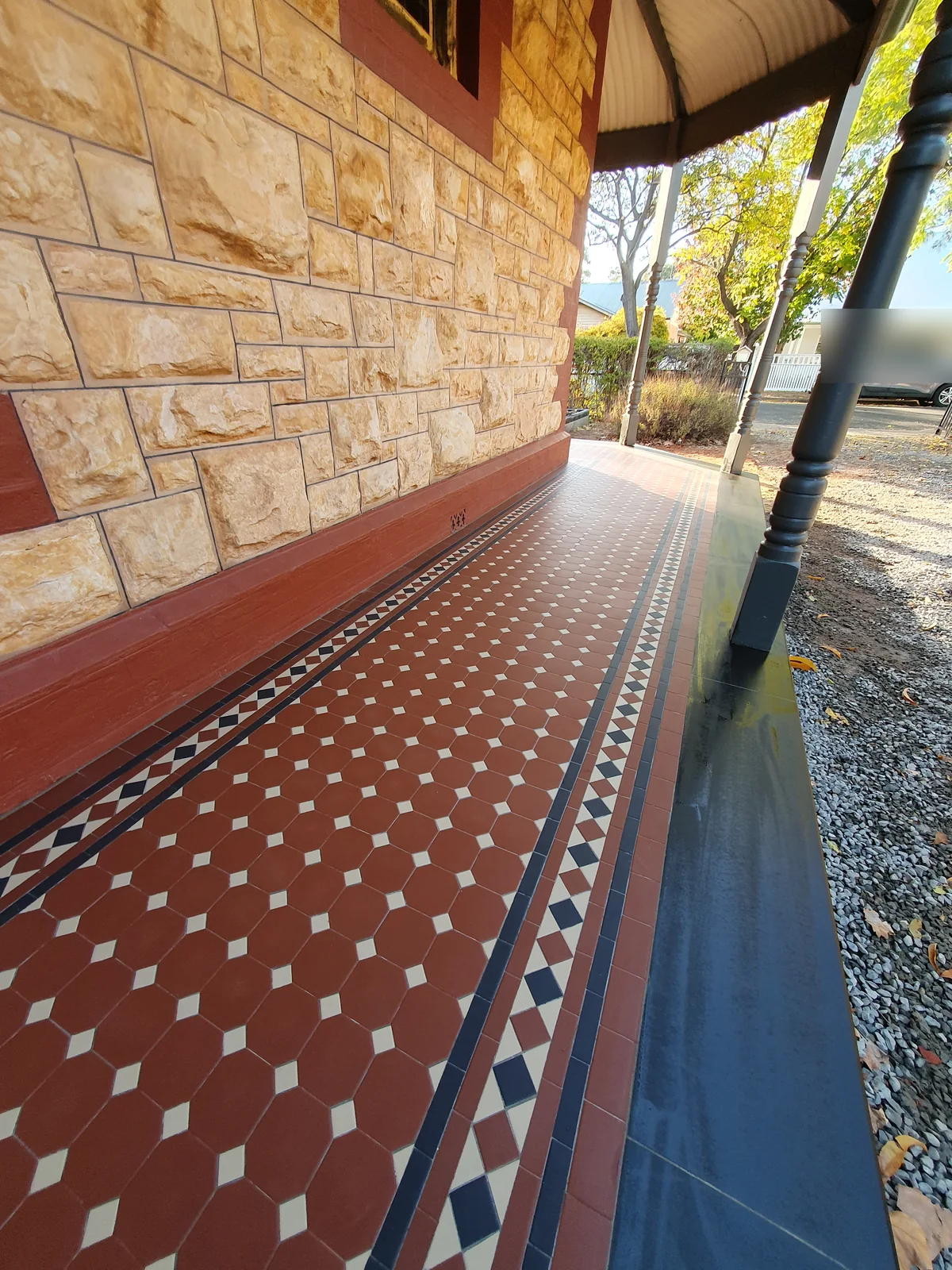
A local context for heritage-minded tile work
Campbelltown City Council describes the area as Adelaide's inner eastern suburbs. Its history page records Third, Fourth and Fifth Creeks running through the area to the River Torrens, while the council's local-history collection documents places such as Magill Institute, Magill Post Office and Manresa Cottage at Athelstone. These references are useful prompts for understanding a property's setting, but they do not establish that every home is heritage-listed or that one tile pattern belongs to the whole area.
A tile scheme can acknowledge a home's proportions and streetscape without copying a historic detail that is not present. Start by documenting the existing verandah, entry, pathway or floor, then consider scale, border treatment, transitions and the relationship between new work and surviving fabric. Where a property is listed or affected by a planning control, confirm the applicable requirements with the relevant authority before work begins.
Who we are | Campbelltown City CouncilHistory of the City of Campbelltown | Campbelltown City CouncilLocal history stories - places | Campbelltown City Council
Use the heritage record as a starting point, not a blanket rule
The City of Campbelltown Heritage Survey (1996) identified 106 places of architectural or historical interest, including four places on the State Heritage Register and one place nominated for that register. The council also notes that some surveyed places have since been altered or demolished. A survey of this kind is a valuable starting point for research, but the status and condition of an individual property still need to be checked on their own terms.
For a heritage-sensitive project, retain useful evidence where practical, distinguish repair from replacement, and record the existing tile layout before selecting a new scheme. A consultation can then focus on proportion, colour balance, edge details and the practical requirements of the site rather than assuming a standard treatment.
Design and craftsmanship for verandahs, entries and paths
Campbelltown-area projects may call for different responses: a restrained new verandah layout, a carefully matched repair to an existing tessellated floor, or a coordinated pathway with a clear border and transition at the threshold. The right choice depends on what remains, how the space is used and how the proposed work meets the building.
Good craftsmanship begins with close observation. Tile selection, setting-out, edge treatment and installation sequencing should be considered together, with restoration decisions separated from new-work decisions. The service can also coordinate stone bullnose or edging where that detail is part of the design brief.
Campbelltown area directory
Your Heritage Tiling Questions
Is every older home in the Campbelltown service area heritage-listed?
No. The council's 1996 heritage survey identified places of architectural or historical interest, but that does not mean every older home is listed or protected. Check the individual property and relevant South Australian planning and heritage information before assuming that an approval or special control applies.
Which Campbelltown-area localities can this service directory help me navigate?
The existing route set covers Campbelltown, Magill, Rostrevor, Athelstone, Paradise, Newton, Hectorville, Tranmere and Dernancourt. The route set is a service-directory grouping and should not be treated as a legal council boundary. The official council material specifically describes parts of Magill and Rostrevor within the City of Campbelltown.
How should I approach tessellated tiles in a heritage-sensitive project?
Begin with a record of the existing floor, verandah or path, including its layout and edge details. Then separate repair or retention decisions from new-work decisions and check any property-specific heritage or planning requirements. Design consultation can help compare proportion, pattern, border and transition options before supply and installation are planned.
What local history can inform a Campbelltown tile design?
The council's local-history resources document places including Magill Institute, Magill Post Office and Manresa Cottage at Athelstone, and the council history page records the area's creek corridors and River Torrens connection. These references can provide design context, but they should not be treated as proof that a particular pattern or material belongs on every property.
Discuss Your Heritage Tiling Project
Share your location, project details and photographs using our enquiry form, or call 0433 932 711.