Project Overview
Authentic Heritage Tiling Co was engaged to deliver a complete heritage replication project for a significant Victorian property in Glebe — one of Sydney's oldest and most architecturally important inner-city suburbs. This was not a standard installation but a new-for-old heritage replication, requiring the faithful reproduction of the property's original tessellated tile pathway to satisfy Heritage Council requirements while delivering a surface built to endure for another century.
The scope encompassed the complete removal of the existing deteriorated tessellated tiles, construction of a new reinforced concrete substrate, and the supply and installation of a herringbone tessellated tile design with a custom decorative border that precisely replicates the original layout. Additionally, the project included the restoration of the property's original Carrara marble steps — damaged and eroded through decades of exposure — returning them to virtually brand-new condition using a combination of traditional stone restoration techniques and the latest technological processes.
Glebe's heritage streetscapes are protected under stringent conservation guidelines, and any work to listed or contributory properties must demonstrate that the replacement materials and design are faithful to the original. This places an extraordinary responsibility on the tiling contractor — not merely to install tiles competently, but to deliver a historically accurate replication that will satisfy heritage assessors and preserve the property's contribution to Glebe's architectural character. Authentic Heritage Tiling Co's specialist expertise in heritage tessellated tile replication made us the natural choice for this demanding project.
Heritage Replication Requirements
Heritage replication projects carry obligations that extend far beyond standard tessellated tile installations. The Heritage Council's requirements for this Glebe property stipulated that the replacement tessellated tiles must replicate the original design in pattern, proportion, colourway, and material composition. This meant conducting detailed analysis of the existing tiles — despite their deteriorated condition — to determine the precise herringbone orientation, tile dimensions, colour palette, and border configuration that had been laid when the property was first constructed.
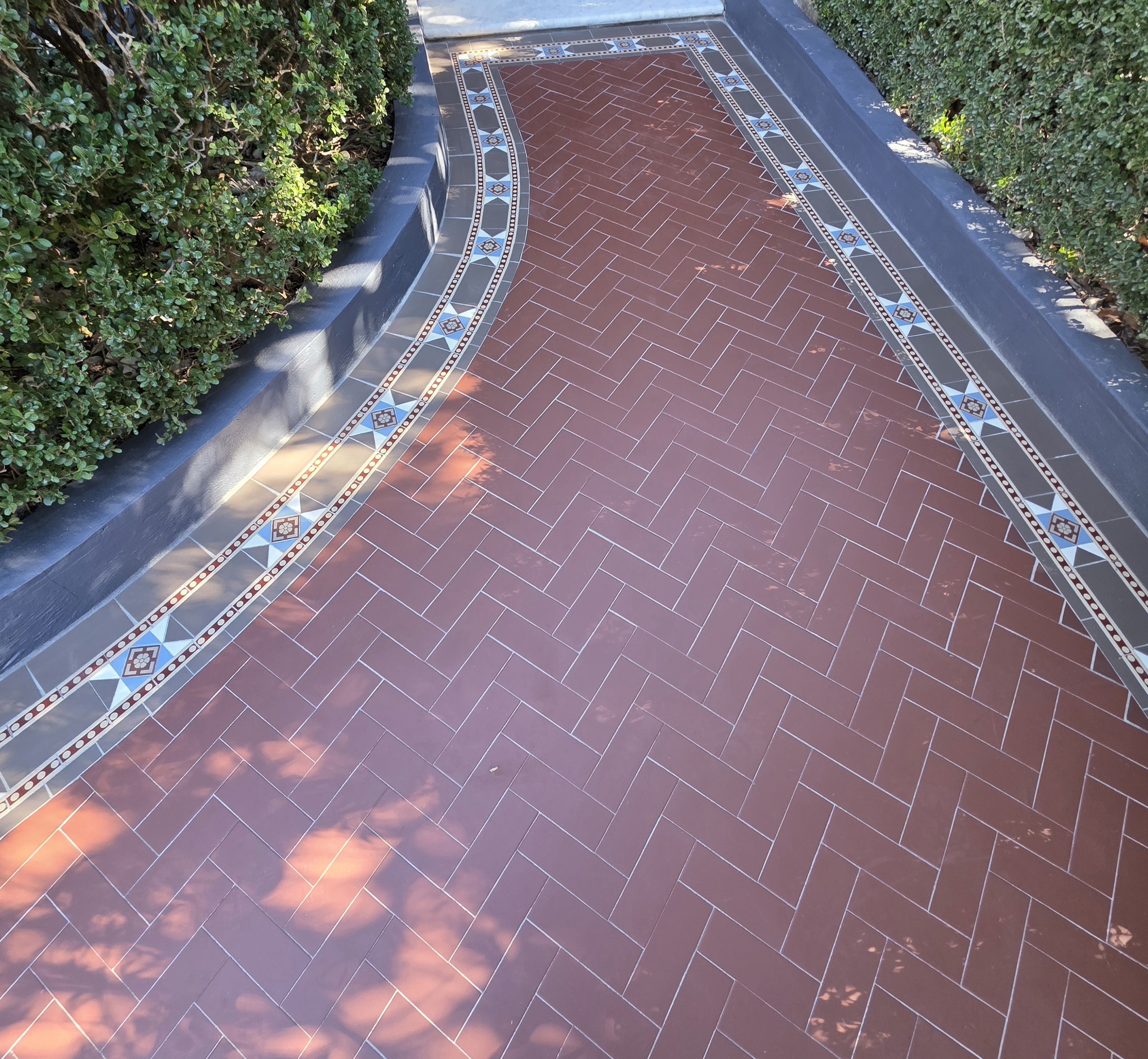
Our heritage assessment team documented the original installation through detailed photography, measurement, and colour analysis before any demolition commenced. The terracotta-toned herringbone field tiles were matched against our extensive palette to identify the precise shade and finish that would replicate the original. The custom decorative border — featuring blue and cream encaustic elements with geometric motifs — required careful documentation of the repeating pattern sequence, tile dimensions, and colour relationships to ensure the replication would be indistinguishable from the original when viewed alongside any remaining heritage fabric on the property.
This level of documentation and analysis is what distinguishes genuine heritage replication from general tessellated tile installation. It requires intimate knowledge of Victorian-era tiling conventions, an understanding of how materials age and patinate, and the technical skill to source or commission tiles that will integrate authentically with the property's heritage character.
Preparation Works
The preparation phase for this Glebe project was extensive and technically demanding. The existing tessellated tiles — cracked, loose, and compromised by decades of substrate failure beneath — were carefully removed in their entirety. This demolition phase required precision to avoid damaging the adjacent Carrara marble steps and surrounding heritage fabric. Our team worked methodically, removing tiles and failed substrate material down to stable ground.
With the site cleared, we constructed formwork for the new reinforced concrete substrate — engineered to the precise levels and falls required for effective water drainage away from the building envelope. The pathway's curved geometry presented additional complexity in formwork construction, requiring custom-shaped forms to achieve the sweeping curve that characterises this property's front approach. Steel reinforcement mesh was installed throughout, and the concrete was poured to exacting tolerances — providing a substrate with the structural integrity to resist cracking, movement, and thermal cycling across Sydney's climate for generations.
The substrate was finished to a smooth, level surface with falls calibrated to shed water efficiently without pooling — critical for any external tessellated tile installation in Sydney's rainfall conditions. After adequate curing time, the surface was primed and prepared for tile adhesion, ensuring maximum bond strength between the new concrete base and the heritage tessellated tiles above.
The Installation Process
The three-day installation program commenced with meticulous setting-out of the herringbone pattern and custom border geometry. For a curved pathway like this Glebe project, the setting-out phase is particularly complex — the herringbone pattern must flow naturally around the curve while maintaining consistent tile spacing and orientation, and the decorative border must follow the pathway's sweeping geometry with uniform width on both sides.
Day one focused on establishing the border framework — laying the custom decorative border along both edges of the pathway to create the fixed boundaries within which the herringbone field would be installed. The border features blue and cream encaustic tiles arranged in a geometric pattern with small square motifs at regular intervals, framed by dark banding that provides strong visual definition. Installing the border first on a curved pathway ensures consistent width and alignment throughout — a technique that requires experience and precision to execute correctly.
Days two and three were dedicated to the herringbone field installation and grouting. The terracotta-toned rectangular tiles were laid in the classic herringbone arrangement — each tile positioned at 45 degrees to the pathway direction, creating the characteristic zigzag pattern that has been used on heritage pathways since the Victorian era. On a curved pathway, the herringbone requires careful adjustment at the borders — tiles must be cut precisely to meet the decorative border at clean angles while maintaining the visual rhythm of the pattern throughout the curve.
Grouting was completed with a colour-matched grout that defines the herringbone joints without competing with the warm terracotta palette. The entire installation was sealed with a premium penetrating sealer formulated for external heritage tessellated tile applications — providing long-term protection against moisture ingress, staining, and UV degradation while allowing the tiles to breathe naturally.
Carrara Marble Step Restoration
A distinctive element of this Glebe project was the restoration of the property's original Carrara marble steps. These steps — a hallmark of high-quality Victorian-era construction — had suffered significant damage and erosion through decades of foot traffic, weather exposure, and the natural effects of Sydney's coastal climate on marble surfaces. The once-crisp edges had rounded, the polished surface had dulled and pitted, and staining had penetrated into the stone's porous structure.
Authentic Heritage Tiling Co's marble restoration process combines traditional stone restoration techniques with the latest technological advances in surface treatment. The restoration began with careful cleaning to remove decades of accumulated grime, biological growth, and surface contaminants without damaging the underlying marble. We then addressed structural damage — filling chips, cracks, and erosion pits with colour-matched marble repair compounds that bond permanently with the original stone.
The surface restoration involved progressive diamond grinding and honing to remove the damaged outer layer and reveal fresh, undamaged marble beneath. This process was carefully controlled to remove only the minimum material necessary — preserving the steps' original dimensions and profiles while achieving a surface finish that matches the original polished appearance. The final stage involved the application of a specialist marble sealer that penetrates the stone's pore structure, providing invisible protection against future moisture damage and staining while maintaining the natural appearance and breathability of the Carrara marble.
The result is a set of marble steps restored to virtually brand-new condition — their original elegance and craftsmanship revealed once again after decades of deterioration. Combined with the new tessellated tile pathway, the restored steps create a cohesive heritage entrance that honours the property's Victorian origins with the quality and attention to detail that Glebe's heritage character demands.
The Result
The completed Glebe project is a comprehensive heritage restoration that demonstrates Authentic Heritage Tiling Co's full spectrum of specialist capabilities — from heritage assessment and documentation through substrate construction, tessellated tile replication, and marble restoration. The herringbone pathway with its custom decorative border flows elegantly along the property's curved front approach, the warm terracotta tones complementing the surrounding garden hedges and the property's Victorian facade.
The custom border provides refined visual framing — the blue and cream encaustic elements adding colour interest and period authenticity that elevates the installation beyond a simple herringbone floor into a genuine heritage feature. The restored Carrara marble steps gleam at the pathway's terminus, their crisp edges and polished surfaces providing a fitting conclusion to the approach sequence.
This project satisfies the Heritage Council's requirements for faithful replication of the original design — the pattern, proportions, colourways, and material quality all honour what was originally laid on this property during the Victorian era. More than mere compliance, however, the installation represents a genuine restoration of heritage character — returning this significant Glebe property's entrance to the standard of craftsmanship it deserves.
For homeowners in Glebe, Forest Lodge, Annandale, Camperdown, Newtown, or anywhere across Sydney's inner city considering heritage tessellated tile replication or marble restoration, Authentic Heritage Tiling Co provides the specialist expertise required to satisfy Heritage Council requirements while delivering results of exceptional quality. Contact us today to discuss your heritage restoration project and discover how our team can help preserve your property's architectural significance for generations to come.