
Tessellated tiles in Willoughby East
Willoughby East is a Lower North Shore residential suburb in the Willoughby local government area. For a verandah, entry, pathway or interior floor, the right tile layout should respond to the property that is actually there: its proportions, light, thresholds, existing fabric and the way new work meets older surfaces. AHTC can help with tessellated tile design, supply, installation and restoration planning for properties in Willoughby East.
A local setting with documented civic history
Willoughby East's local story includes the Albert Chowne Memorial Hall at the corner of McClelland and Warrane Roads. Willoughby City Library records that the 1954 hall was designed by Eric Nicholls, an honorary architect of Willoughby Council and former partner of Walter Burley Griffin, and that it was later extended and refurbished. This is a specific civic reference point, not a claim that every nearby house has the same architectural character or heritage status.
The council's planning material also identifies Willoughby Park in Willoughby East. For private property work, the useful lesson is to read the immediate setting carefully rather than apply a generic period label: retain meaningful existing details where possible, and use new tile work to sit comfortably with the building's scale and circulation.
Albert Chowne Memorial Hall — Willoughby City LibraryWilloughby City Council Local Strategic Planning Statement to 2036
Design choices for verandahs, paths and entries
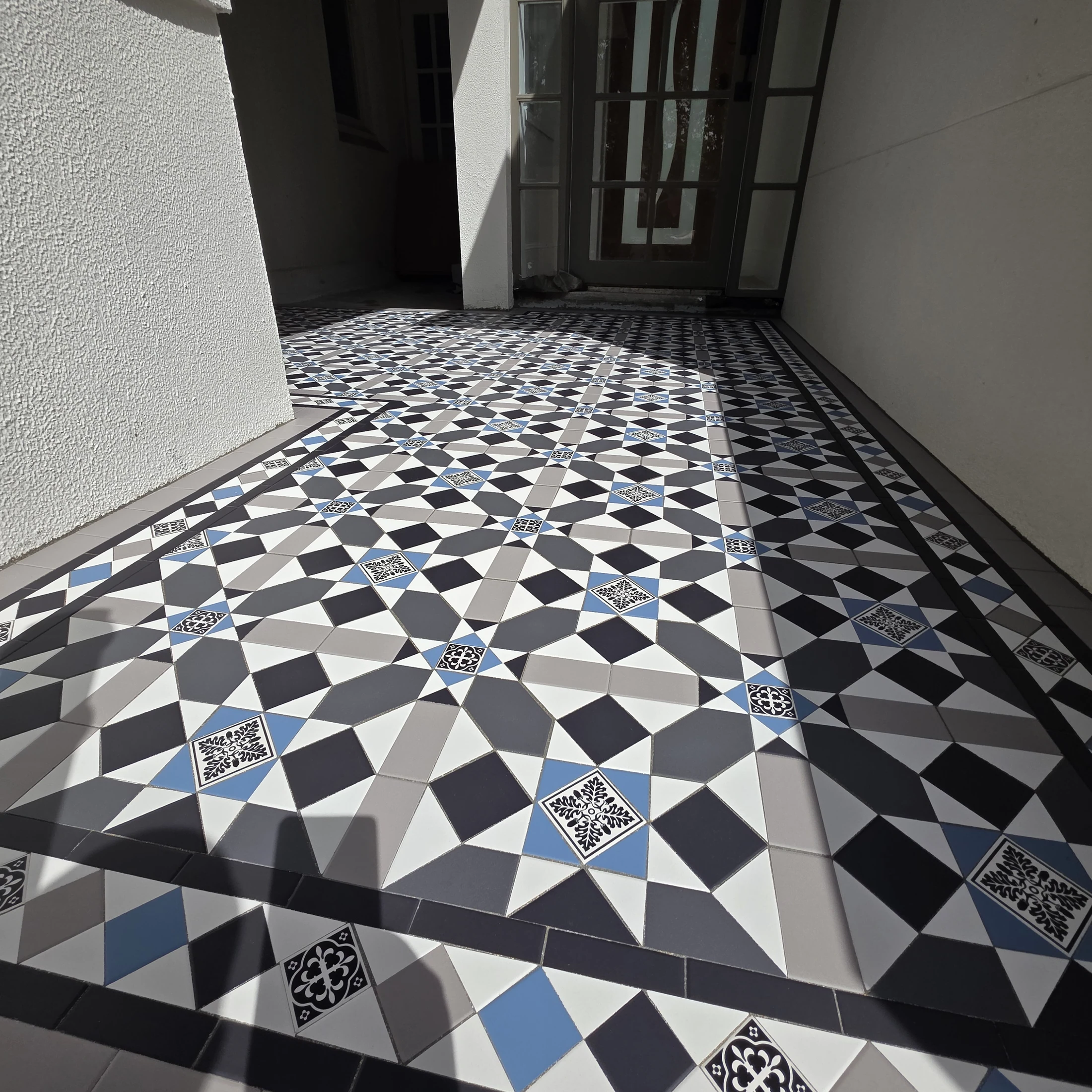
A Willoughby East tile scheme can be developed around the path people actually take through the property. A narrow entry may benefit from a disciplined border and a clear transition at the threshold, while a broader verandah can give the field pattern more room to read. Border width, corner turns, step edges and the relationship between tile and masonry should be considered together rather than selected as isolated details.
Where original tiles remain, matching should begin with what can be observed on site: pattern, colour balance, edge pieces, wear and the condition of the setting. Where a new installation is planned, the design can take cues from the property's proportions without pretending that a single historical style applies across Willoughby East.
Careful restoration and new work
Restoration starts with condition and significance. Existing tiles may need careful assessment before lifting, cleaning, repairing or extending a pattern. New work should be coordinated with the existing floor, steps, walls and drainage conditions so that edges and transitions are resolved as part of the design.
The Willoughby heritage review uses property-specific assessment and conservation principles. If a property is individually listed, within a conservation area or otherwise subject to a planning control, the relevant council and planning information should be checked before work begins. A tile service can support design and construction coordination, but it does not provide heritage approval.
Your Heritage Tiling Questions
Does every Willoughby East property require heritage approval for tile work?
Not necessarily. Heritage controls are property-specific. Check whether the property is individually listed, in a conservation area or affected by another planning control before work begins; the Willoughby heritage review itself distinguishes individual assessments from broader area assumptions.
Can new tessellated tiles suit a non-period home in Willoughby East?
Yes. The design can respond to the home's proportions, thresholds, light and circulation without copying a period scheme. The most reliable starting point is the property itself and the way the new work will meet adjoining materials.
What should be checked before restoring an existing tiled entry or verandah?
Record the existing pattern and edges, inspect the condition of the tiles and setting, and consider how the floor meets steps, walls and drainage. If the property has heritage controls, check the relevant council and planning requirements before lifting or altering fabric.
Can AHTC help with a Willoughby East pathway or verandah?
AHTC's locality service covers design consultation, tessellated tile supply, installation and restoration planning, including pathway and verandah tile work. The appropriate layout and construction approach depend on the property's existing conditions and the intended use.
Discuss Your Heritage Tiling Project
Share your location, project details and photographs using our enquiry form, or call 0433 932 711.