
Tessellated Tiles in Richmond, SA
Richmond sits within the City of West Torrens in Adelaide's western suburbs. Its documented historic-area context includes inter-war homes, State Bank bungalow and art deco examples, semi-detached and row housing, and a consistent streetscape where roof forms, verandahs, brickwork and front setbacks contribute to the setting. A tessellated tile scheme can respond to those proportions without copying a period detail that does not belong to the property. AHTC can help with design consultation, tessellated tile supply, installation, restoration and stone bullnose or edging coordination.
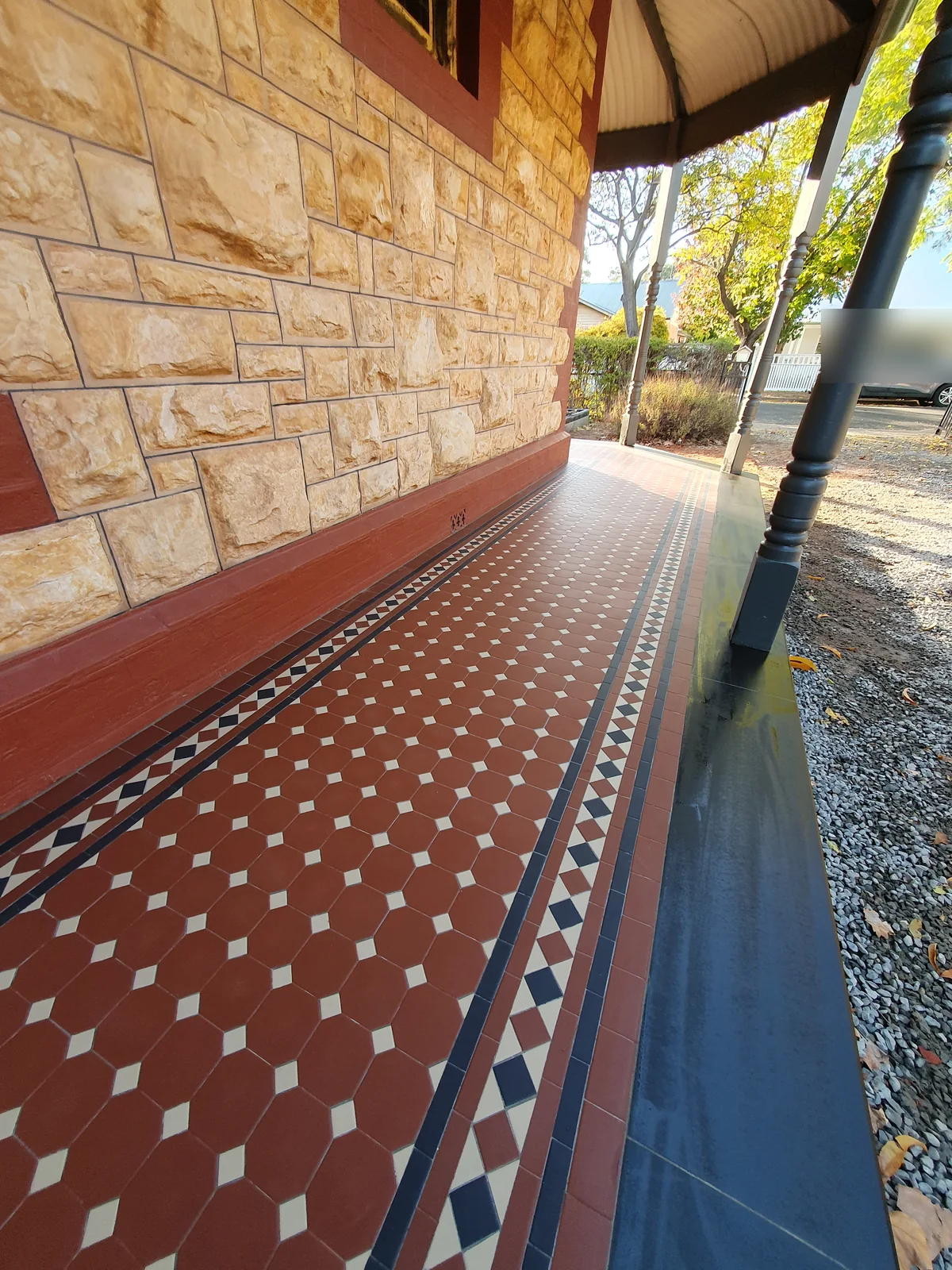
Tile design for Richmond's historic-area context
The Richmond historic-area statement describes rectangular allotments with direct street frontage, predominantly row and semi-detached dwellings, and some detached homes. It also refers to inter-war, State Bank bungalow and art deco examples, with complementary verandahs or porticos and a consistent material palette. For a front path, porch or verandah, those observations make scale and transition as important as the motif itself: the layout should sit comfortably with the entry width, threshold and existing façade rather than overwhelm them.
Patterns can be developed around the geometry of the site, the direction of approach and the relationship between the main field, border and edge. Where existing tiles remain, careful assessment of colour, dimensions, wear and surrounding masonry can inform a repair or a sympathetic extension. New work should be clearly planned for its own purpose while respecting the established rhythm of the house and streetscape.
The fact sheet relates to a defined overlay and its statement does not mean every Richmond property is heritage-listed. Before changing a property in a character or historic area, check the current South Australian planning information for that property and obtain any advice or approval that may apply. Heritage-sensitive tile design is not the same as heritage authority endorsement.
Restoration, new installation and considered edges
For an older Richmond floor or pathway, the first useful step is to understand what is actually there: loose or drummy tiles, worn surfaces, failed joints, movement, drainage and the condition of adjoining thresholds can all affect the appropriate response. Retaining sound original material may lead to a different design decision from replacing a later, unrelated surface.
For new verandahs and pathways, layout decisions include the border, direction changes, thresholds, falls and the meeting point with brick, render or stone. Stone bullnose or edging coordination can provide a deliberate finish at exposed edges, steps or transitions where the site calls for it. The installation approach should be confirmed after reviewing the property and the intended use rather than assumed from the suburb alone.
Property-specific planning checks
West Torrens distinguishes formal heritage listing from broader historic themes and character areas. The Richmond fact sheet also makes clear that its historic-area statement applies to properties or development within the overlay. That is why a property-specific check is important before removing established fabric or changing a prominent front approach.
AHTC can help you frame the tile and edging design questions for an initial discussion. If the work sits within an overlay or affects a listed place, confirm the current Planning and Design Code requirements and any approval pathway with the relevant South Australian planning authority before work begins.
Your Heritage Tiling Questions
Can a Richmond tessellated tile design suit an inter-war or art deco home?
It can, provided the pattern, scale, border and colour relationships are developed for the particular entry, verandah or path. The Richmond historic-area statement identifies inter-war and art deco examples, but it does not prescribe one tile pattern for every property.
Does living in Richmond mean my home is heritage-listed?
No. Richmond's documented historic-area context includes an overlay and character statement, while formal heritage listing is a separate legal recognition. Check the current property-specific planning information before assuming that a listing or overlay applies.
Should existing tessellated tiles be repaired or replaced?
That depends on the condition and significance of the existing surface, including tile stability, wear, joints, movement, drainage and the surrounding thresholds. An assessment can separate repairable original fabric from later surfaces before a design is selected.
Can a Richmond verandah or pathway include stone bullnose or edging?
Stone bullnose or edging can be considered where it suits the step, exposed edge or transition. Its profile, junctions and proportion should be coordinated with the tile layout and the existing building rather than treated as a universal detail.
Discuss Your Heritage Tiling Project
Share your location, project details and photographs using our enquiry form, or call 0433 932 711.