
Tessellated Tiles Denistone
Denistone's history reaches from the former Denistone estate and its 1913 subdivision to the residential streets shaped by later transport and municipal planting. For a Denistone home, a tessellated tile scheme can be planned around the property's proportions, the way a verandah or path meets the garden, and any surviving fabric worth retaining. Design consultation, tile supply, installation and restoration can be considered as one coordinated process, with the condition and character of the individual property leading the decisions.
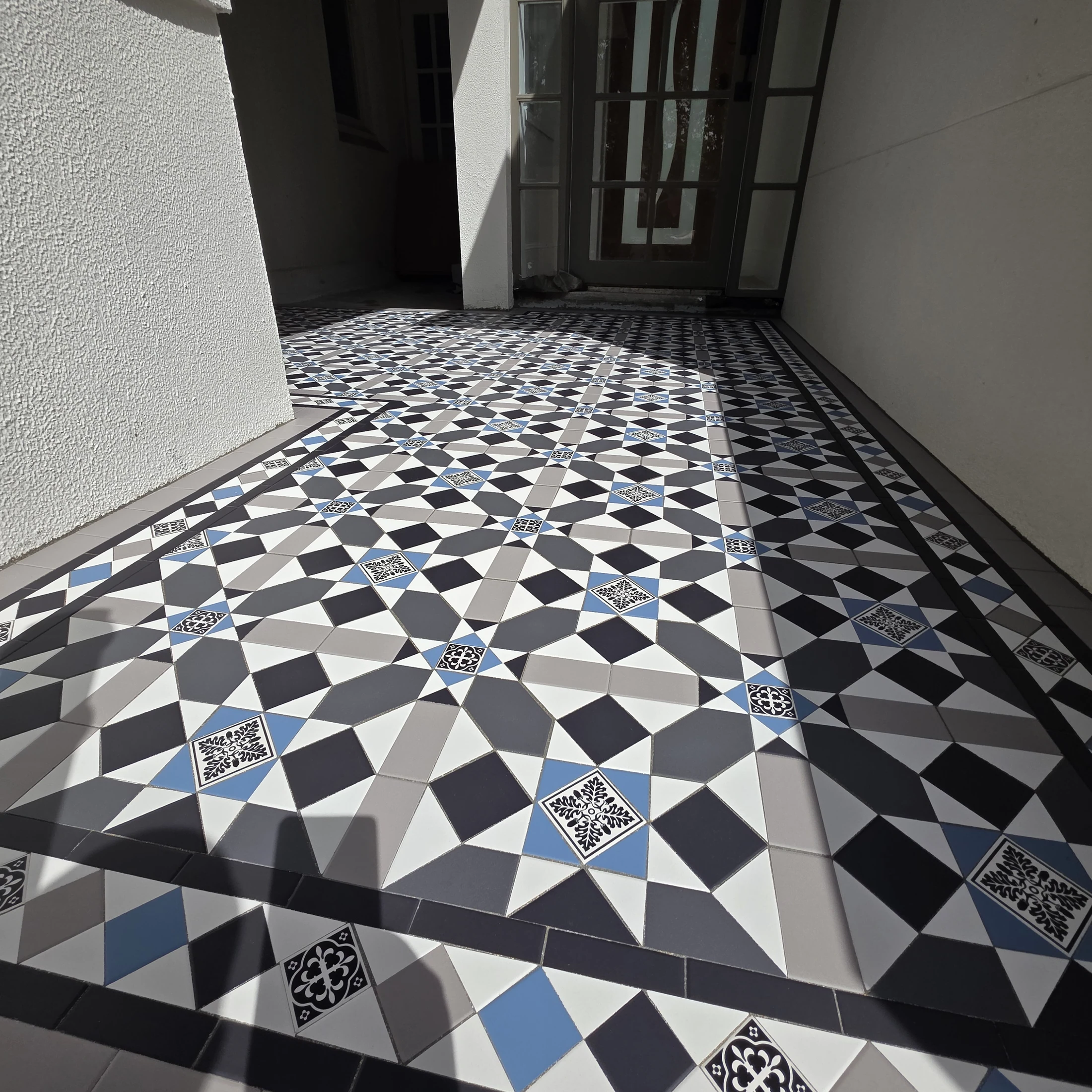
A locality shaped by estates, subdivision and streetscape
Denistone takes its name from Dennistone, the home associated with Thomas Forster. The estate remained consolidated for much of the nineteenth century before being opened for sale in 1913. A railway platform between West Ryde and Eastwood opened in 1937 and helped establish Denistone as the locality name. [1] [4]
That layered history is useful design context rather than a claim that every home has the same period or level of heritage significance. A new verandah, entry path or internal floor should be assessed against the actual building, its proportions, its garden setting and any surviving original details.
Working with Denistone's mature streetscape cues
The City of Ryde's heritage review records brush box avenues and alignments in parts of Anthony Road, Miriam Road and West Parade. It describes the trees and their wide lawn verges as an important part of the Denistone and West Ryde urban forest, with a distinctive canopy and a connection to post-Federation and interwar streetscape treatments. [2]
For a property near these streetscapes, the setting can inform choices about path width, border scale, sightlines and transitions at the verandah. The aim is not to copy a street detail indoors, but to let the tile geometry sit comfortably with the home's entry sequence, planting and available daylight.
Check the property before changing original fabric
The City of Ryde heritage review lists Denistone street trees, a house and garden at Miriam Road, and the Chatham Road and Darvall Estate heritage conservation areas. The council explains that work affecting a heritage item or a conservation area should be sympathetic to its character and style.
A heritage-sensitive tile brief starts with a property-specific check: identify whether the work concerns an existing tiled surface, a later alteration or new work; photograph edges and thresholds; note any areas that are loose, cracked or uneven; and confirm the relevant planning and heritage requirements with the appropriate authority before work proceeds. Heritage listing does not mean every home is listed, and a tiling service does not provide heritage approval.
Design and craftsmanship for verandahs, paths and floors
Denistone projects benefit from a measured approach to pattern, scale and junctions. For a verandah or front path, a border can clarify the edge while keeping the field pattern proportionate to the run of the space. Indoors, the pattern can be related to room geometry, skirtings and door thresholds rather than applied as a disconnected feature.
Restoration calls for a different starting point from new installation. Existing tiles, bedding and edges should be assessed before deciding what can be retained, repaired, carefully matched or replaced. Stone bullnose or edging coordination may be useful where a tiled surface meets steps, a garden edge or another material.
A considered local tiling service
Begin with the property and the task: a new tessellated floor, a verandah or pathway, or the repair of an existing surface. Design consultation can help establish the layout and edge treatment before supply and installation are coordinated. Where original fabric is present, restoration planning can focus on retaining what is sound and making any new work read naturally alongside it.
The Denistone page sits within the Ryde service directory and connects with broader Sydney guidance for tessellated tile design, installation and restoration. This keeps the local context useful without suggesting a local office or a council endorsement.
Your Heritage Tiling Questions
Does every Denistone property need heritage approval for tessellated tiling?
No. Denistone includes listed heritage items and heritage conservation areas, but a suburb-wide label does not make every property listed. Check the individual property, the proposed work and the applicable planning and heritage requirements with the relevant authority before proceeding. [3]
What Denistone features can inform a tile design?
The locality's estate history, residential subdivision and mature brush box streetscapes can provide context for proportion, entry sequence, path edges and garden relationships. They are design cues, not proof that a particular house has a defined period style. [1] [2] [4]
Can existing tessellated tiles in a Denistone home be restored?
They may be, subject to an inspection of their condition, edges, bedding and surrounding construction. A restoration assessment should distinguish sound original fabric from later work and set out what can be retained, repaired or matched rather than assuming replacement is necessary.
How should a new verandah or pathway layout be planned?
Start with measured dimensions, the approach to the entry, thresholds, drainage and the relationship between the tiled surface and garden or steps. A restrained border and a field pattern scaled to the space can help the work sit comfortably with the property rather than overwhelm it.
Is Denistone part of the City of Ryde?
Yes. Denistone is identified as one of the suburbs forming the City of Ryde, within metropolitan Sydney. The Ryde grouping on a service page is a navigation context and should not be read as a statement that every planning or heritage question is determined by a service-directory label. [4]
Discuss Your Heritage Tiling Project
Share your location, project details and photographs using our enquiry form, or call 0433 932 711.