
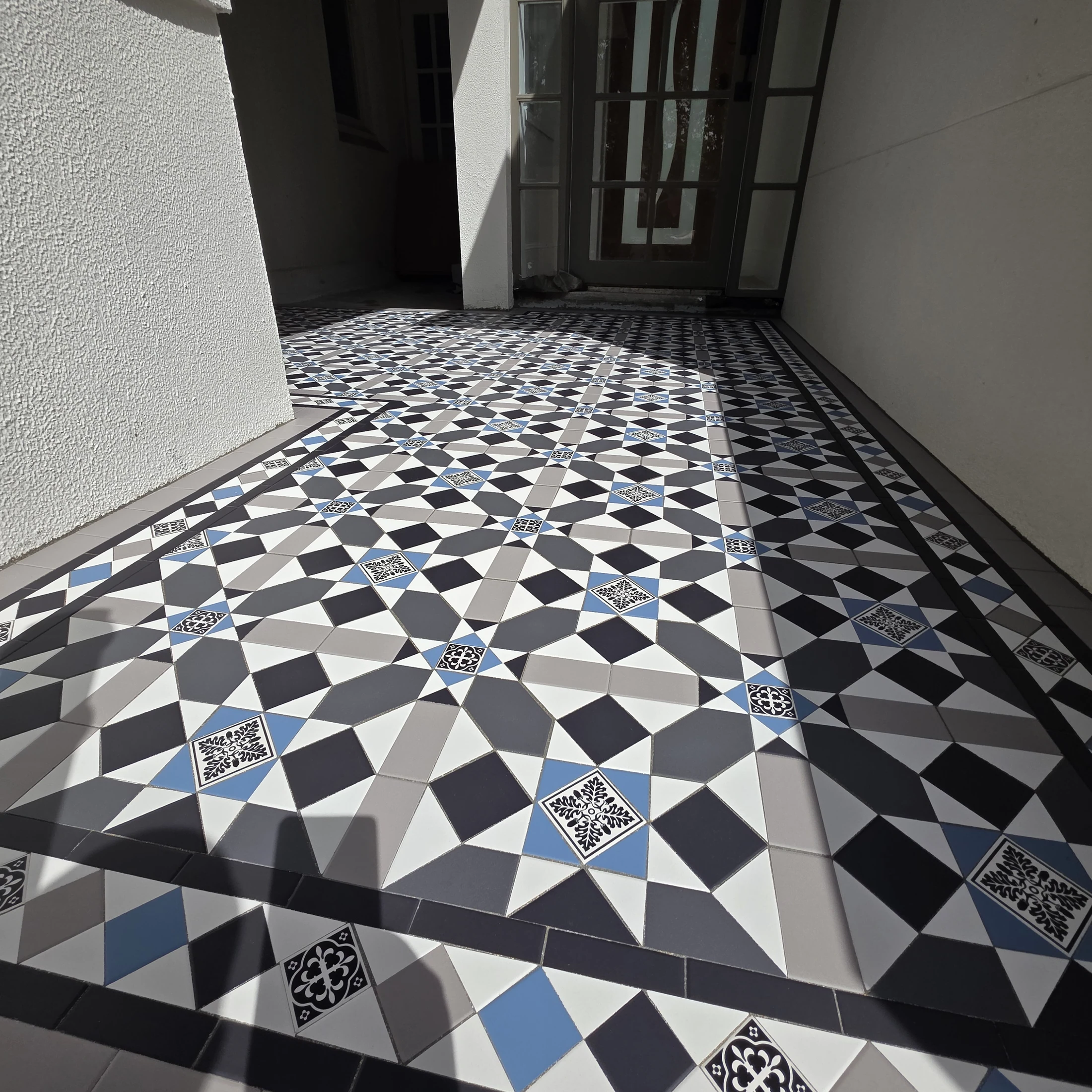
Tessellated tiles in Kingsford
Kingsford's predominantly residential streets combine surviving Federation and Inter-War dwellings with later infill and a busier town-centre and apartment setting. For a verandah, entry, pathway or interior floor, a useful starting point is to understand the property's existing proportions, thresholds and surviving materials before choosing a new tessellated layout or planning restoration.
A local setting of Federation, Inter-War and later homes
Randwick's heritage study describes Kingsford as a mainly residential suburb with generally flat or gently undulating land, a north-south ridgeline and a grid of streets around Anzac Parade. It identifies detached single-storey Federation and Inter-War dwellings as a broad part of the built character, with twenty-first-century infill interspersed. That context can help guide a proportionate tile design, but it does not mean every property is heritage listed.
Kingsford Town Centre adds a different condition: commercial premises, apartments and established residential areas meet along the Anzac Parade and Gardeners Road corridor. A tile scheme for a town-centre apartment, a renovated bungalow or a period home's front path should therefore respond to the individual building rather than assume one suburb-wide template.
Randwick Heritage Study: Items Analysis — Kingsford character statement and gap analysis
Design inspiration from the property, not a copied period label
For an older Kingsford home, begin with the spaces that establish arrival and rhythm: a verandah, porch, front threshold, hall or garden path. Existing tile fragments, stair geometry, brickwork, joinery and the width of adjoining borders can inform a restrained pattern and transition. Where later alterations have changed the entrance, a new scheme can still take cues from the building's scale without pretending to reproduce an undocumented original.
For a newer addition or apartment setting, a simpler border, controlled colour relationship and carefully resolved edge can connect the new work to the surrounding property without manufacturing a heritage claim. Design consultation can help distinguish a sympathetic new installation from restoration of surviving fabric.
Randwick Heritage Study: Items Analysis — Kingsford character statement and gap analysisHeritage Study: Randwick City Council — Volume 1 Heritage Conservation Review
Craftsmanship for verandahs, paths and interior floors
Tessellated work is read at close range as well as from the street. Pattern alignment, consistent joints, clean borders, transitions at doors and a considered finish at steps or exposed edges all affect how the work sits within a Kingsford property. Supply and installation planning should account for the actual room or path proportions, access and the condition of the area rather than rely on a universal layout.
When existing tiles remain, restoration should start with an assessment of what is present and what can be retained. Randwick's heritage study distinguishes preservation, restoration, reconstruction and adaptation; those terms describe different treatments, so the right approach depends on the evidence at the property and the owner's aims.
Heritage Study: Randwick City Council — Volume 1 Heritage Conservation ReviewRandwick Heritage Study: Items Analysis — Kingsford character statement and gap analysis
Check the property-specific planning context
Randwick LEP 2012 contains planning and heritage-conservation provisions and maps for Randwick City. A suburb's period character is not the same thing as an individual heritage listing or a heritage conservation area. Before changing surviving fabric or undertaking substantial external work, check the current official planning and heritage information for the property and obtain independent planning advice where needed.
This page provides tiling design, supply, installation and restoration guidance. It does not provide heritage approvals, certify a property or speak for Randwick City Council.
Local Environmental Plan — Randwick City CouncilWhy does Heritage matter? And what is listed in our draft LEP?
Your Heritage Tiling Questions
Are all older homes in Kingsford heritage listed?
No. The heritage study describes broad Kingsford character and discusses individual potential and listed items, but architectural character alone does not establish that every home is listed or protected. Check the current Randwick planning and heritage records for the specific property.
Can a new tessellated design suit a Kingsford Federation or Inter-War home?
Yes, a new design can be developed with the property's scale, entry sequence, existing materials and surviving details in mind. The design should be based on the individual building rather than assume a period label proves a particular original pattern.
What should be checked before restoring existing tiles in Kingsford?
Start by recording the condition and extent of surviving fabric, including edges, transitions and any later alterations. Then clarify whether the intended work is preservation, restoration, reconstruction or adaptation, and check the property's current planning and heritage context through the official Randwick sources.
Are Kingsford pathways and verandahs suitable for tessellated tiles?
They can be considered as part of a property-specific design, with the pattern, border, thresholds, steps, drainage exposure and edge treatment resolved for the actual site. The appropriate solution depends on the existing surface and the way the space is used.
Discuss Your Heritage Tiling Project
Share your location, project details and photographs using our enquiry form, or call 0433 932 711.