
Tessellated tiles in Huntingdale
Huntingdale's mix of low-scale homes, newer medium-density housing, fine-grain shops and industrial buildings calls for a considered approach to tile selection. Authentic Heritage Tiling Co can help with tessellated tile design, supply, installation and restoration, including verandah and pathway layouts and stone bullnose or edging coordination. Start with the property's existing fabric, intended use and the way new work will meet adjoining surfaces.
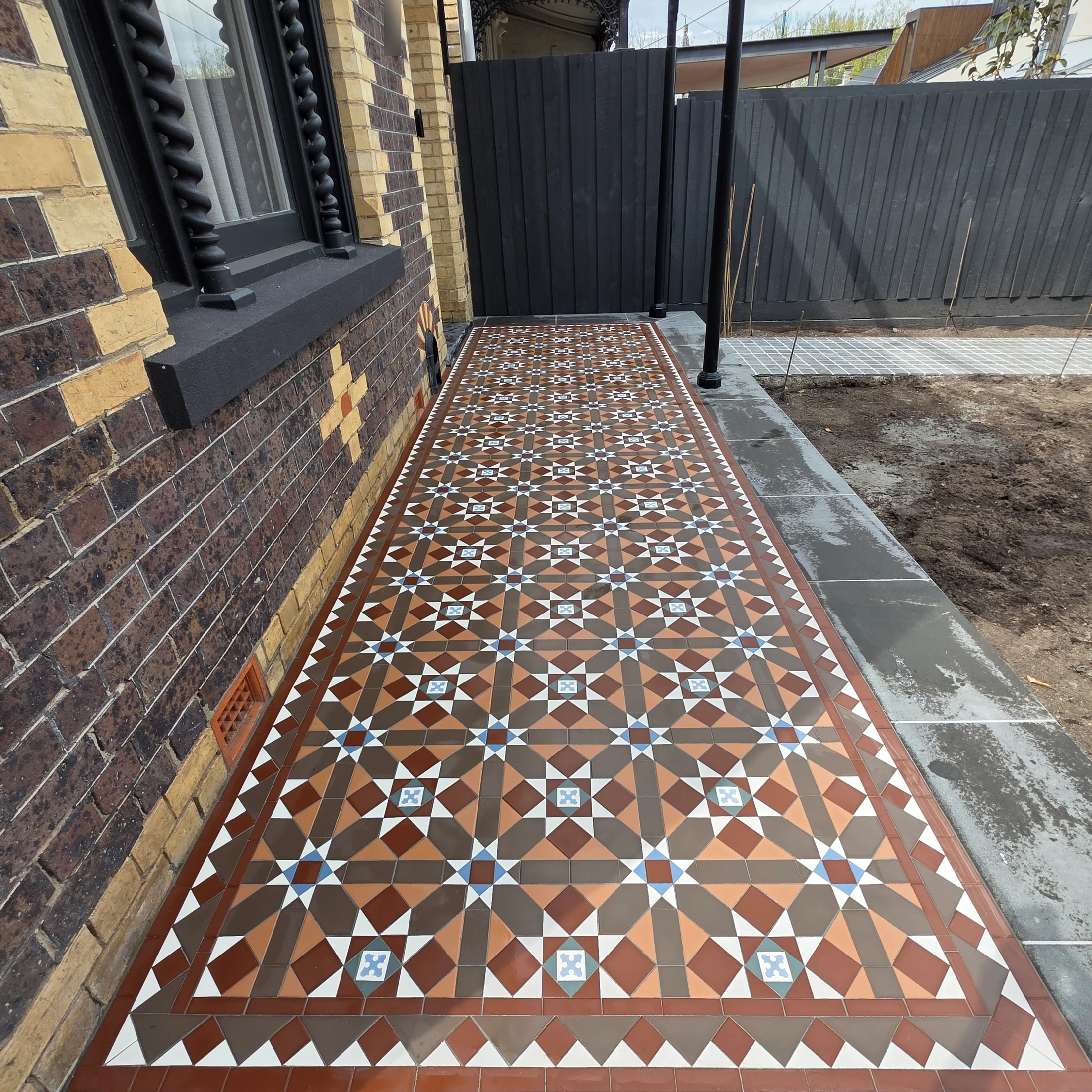
A varied local setting needs a property-led tile design
The City of Monash identifies Huntingdale as one of its Melbourne south-east suburbs. Council's precinct material describes a varied local character shaped by residential, commercial and industrial uses. Residential streets include generally low-scale detached dwellings of different ages, newer medium-density development and garden setbacks, while Huntingdale Road has a fine-grain retail character.
That variety makes a site inspection and a measured design conversation more useful than assuming one Huntingdale pattern suits every property. A restrained border and proportioned field can sit comfortably in a period-influenced setting, while a new extension or townhouse entry may need a clearer transition between original and contemporary work. Colour, scale, threshold levels and the relationship to paving or garden edges should be resolved together.
Respecting existing fabric without assuming a heritage listing
The Huntingdale precinct plan identifies heritage built form in its place framework and encourages adaptive reuse of suitable existing buildings. Those broad place-planning observations do not mean every Huntingdale property is heritage-listed or that tile work automatically needs approval. For an individual property, check the current planning controls and any applicable overlay before altering significant fabric.
Where older tiles survive, careful assessment can help distinguish loose or damaged areas from a layout that is worth retaining. Matching the visual rhythm, border logic and transitions may be more important than replacing every piece. For a new verandah, porch or pathway, the design can acknowledge the home's proportions while remaining clearly contemporary where that is the better fit.
Verandahs, entries and pathways in Huntingdale
A tessellated pathway or verandah floor is read alongside the front setback, garden planting, steps and the approach to the door. Council's precinct work places emphasis on landscape setbacks, streetscape quality and transitions between different built forms. In practice, that means planning the tile field, edge treatment, drainage falls and thresholds as one composition rather than treating the tiles as an isolated finish.
For exposed paths, the design discussion should cover site levels, weather exposure, pedestrian use and how the new surface meets existing paving. Stone bullnose or edging coordination can provide a considered finish at steps and boundaries where the detail is suitable for the property.
Restoration, supply and installation with a clear scope
For restoration, the useful starting points are the condition of the existing tiles, the extent of movement or loss, the underlying surface and the visual importance of the affected area. For new work, supply and installation can be coordinated around an agreed layout, border, colour direction and edge detail. The appropriate response depends on the property and the intended use; no single substrate or installation method should be assumed in advance.
A consultation can cover design development, tessellated tile supply, installation, restoration and stone bullnose or edging coordination. The existing Huntingdale service page remains the place to bring those related needs together, with broader Melbourne service guidance available where a project extends beyond the locality.
Your Heritage Tiling Questions
Can tessellated tiles suit a Huntingdale home that has been extended or renovated?
Yes, but the layout should respond to the whole property rather than copy a period detail automatically. Existing proportions, the extension's junction with older fabric, thresholds, garden setbacks and the intended level of visual contrast can all guide the design.
Does a Huntingdale property automatically need heritage approval for tile work?
No. A suburb or precinct reference is not proof that an individual property is heritage-listed. Check the property's current planning controls and any applicable heritage overlay before changing significant existing fabric; approval requirements are site-specific.
What should be considered for a tessellated pathway or verandah in Huntingdale?
Consider the relationship between the tile pattern, front setback, steps, garden edges and adjoining paving, as well as levels, drainage, exposure and pedestrian use. A coordinated edge or bullnose detail may be appropriate where it suits the setting.
Can existing Huntingdale tessellated tiles be restored rather than replaced?
Often the decision depends on the condition and extent of the surviving work. An assessment can consider loose or damaged areas, missing pieces, the underlying surface and whether the original layout remains worth retaining before a repair or replacement scope is selected.
Can supply and installation be planned together for a Huntingdale project?
Yes. Design, tile supply, installation and stone bullnose or edging coordination can be discussed as one scope so that the pattern, transitions and finish are resolved before work begins.
Discuss Your Heritage Tiling Project
Share your location, project details and photographs using our enquiry form, or call 0433 932 711.