
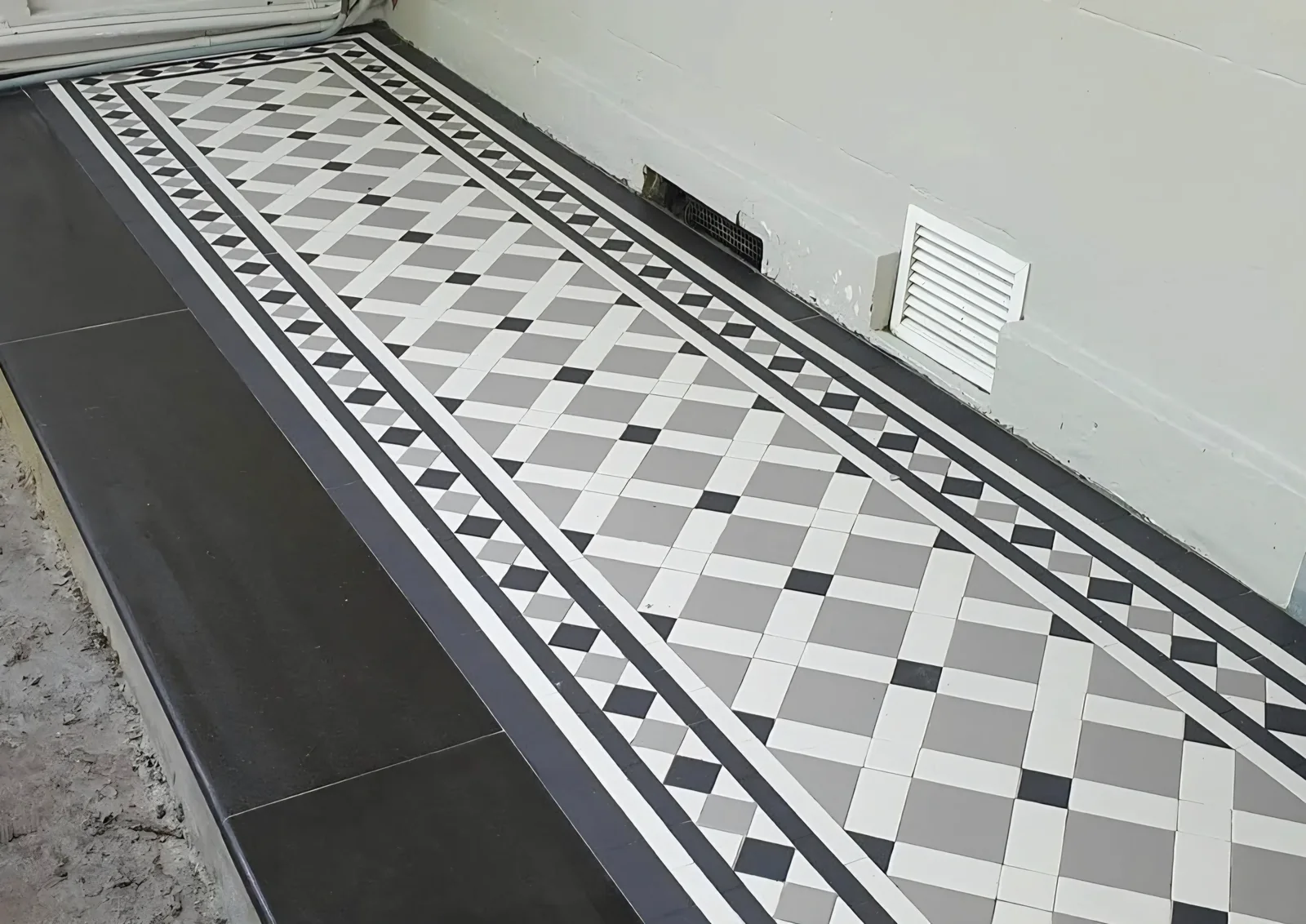
Dulwich Hill, NSW
Dulwich Hill NSW tessellated tiling
Supply and installation tessellated tiles for the verandah, steps and entrance in Dulwich Hill, NSW.
Read the projectDulwich Hill combines leafy residential streets with Victorian, Federation and Interwar-era homes, established gardens and active town-centre and transport corridors. For a verandah, pathway or entrance, tessellated tiles can be selected to sit comfortably with the property's proportions, surviving details and the wider streetscape. Authentic Heritage Tiling Co provides design consultation, tessellated tile supply, installation, restoration and stone bullnose or edging coordination for Dulwich Hill projects.
Inner West Council describes Dulwich Hill as a well-established suburb with a mix of Victorian, Federation and Interwar-era houses, alongside newer medium-density development near transport corridors. Its commercial activity is concentrated around Dulwich Hill and Wardell Roads, while many residential streets retain a quieter, garden-led character.
That variety is a useful starting point for tile design. A restrained border and proportionate pattern may suit a modest front path, while a broader verandah can support a more deliberate geometric layout. The right choice depends on the home's existing façade, steps, fence line, garden setting and the way the tiled area meets public footpaths or other materials.
Council's Dulwich Hill controls call attention to original building and roof forms, traditional subdivision patterns, sandstone features, low front fences, mature street trees and important views. These are practical prompts when planning a new tiled entrance or considering repairs to an older one: keep thresholds, falls, edging, fence relationships and planting in proportion to the property rather than treating the tile pattern as an isolated surface.
Where original tiles or other significant fabric remain, restoration and selective repair should begin with an assessment of what can be retained and matched. New work can then be designed to read as a considered addition without pretending that every Dulwich Hill property has the same heritage status or period details.
4.9 Dulwich Hill — Inner West Development Control PlanInner West Residential Heritage — Inner West Council
Inner West Council lists several Dulwich Hill conservation areas, including Dulwich Hill Commercial Precinct, Hoskins Park and Environs, Abergeldie Estate and South Dulwich Hill. The council's broader heritage guidance explains that an area's significance can come from its landform, subdivision, street pattern, building styles, materials, form and scale.
This is context for careful design, not a blanket statement that every home is listed or that every project needs the same approval. The NSW Planning Portal also records a specific approved heritage-listing proposal for properties on Macarthur Parade. Check the individual property and proposed scope before work begins.
Heritage conservation areas | Inner West CouncilInner West Residential Heritage — Inner West CouncilMacarthur Parade Dulwich Hill Heritage Listings Planning Proposal — NSW Planning Portal
A Dulwich Hill tile project can begin with a review of the existing entrance, verandah or pathway, followed by pattern and colour selection that responds to the building and its setting. Our services include tessellated tile supply, installation, restoration, design consultation and coordination of stone bullnose or edging details.
It is a single approved project example, not a claim about every local property or a universal construction method.
Inner West Council says consent is generally required for development or works on heritage items or within heritage conservation areas, and recommends checking the NSW Planning Portal Spatial Viewer or contacting its duty planners when status is uncertain. A tile consultation can help clarify the proposed scope and the existing fabric, but it is not a heritage approval or planning determination.
For a Dulwich Hill home, keep records of existing tiles and adjoining details, confirm whether the property sits within a conservation area or is individually listed, and obtain the advice or consent required for the specific work before commencement.
Do I need approval? — Inner West CouncilInner West Residential Heritage — Inner West Council
No. Inner West Council identifies heritage conservation areas and individual heritage items, but status varies by property. Council's Dulwich Hill controls identify six conservation areas, and the NSW Planning Portal records specific heritage-listing decisions such as the Macarthur Parade proposal. Check the individual address rather than assuming a suburb-wide designation.
It can, depending on the property and scope. Inner West Council says consent is generally required for development or works on heritage items or within heritage conservation areas. Use the NSW Planning Portal Spatial Viewer or contact Council's duty planners to check the property before starting.
Start with the home's existing façade, period character, front fence, steps, garden setting and the proportions of the verandah or pathway. Council's local controls specifically refer to original building and roof forms, traditional subdivision patterns, sandstone features, mature trees and views, so the tile layout and edging should be considered as part of that broader setting.
That depends on the condition, extent and significance of the surviving fabric. Begin with an assessment of what can be retained and matched, then choose between selective restoration, complementary new work or replacement for areas that cannot be recovered. A property-specific heritage check should occur where a listing or conservation-area status may apply.
Share your location, project details and photographs using our enquiry form, or call 0433 932 711.