
Tessellated tiles in Millers Point
Millers Point's documented character is unusually cohesive: a low-rise residential and maritime precinct shaped by fine-grain streets, sandstone and other traditional materials, terraces, pitched roofs, steep coastal ground, stairs and lanes. If you are planning a tessellated floor, verandah or pathway here, the right starting point is the property and its existing fabric. Authentic Heritage Tiling Co can help coordinate design consultation, tessellated tile supply, installation planning and restoration assessment while keeping heritage questions with the relevant authority.
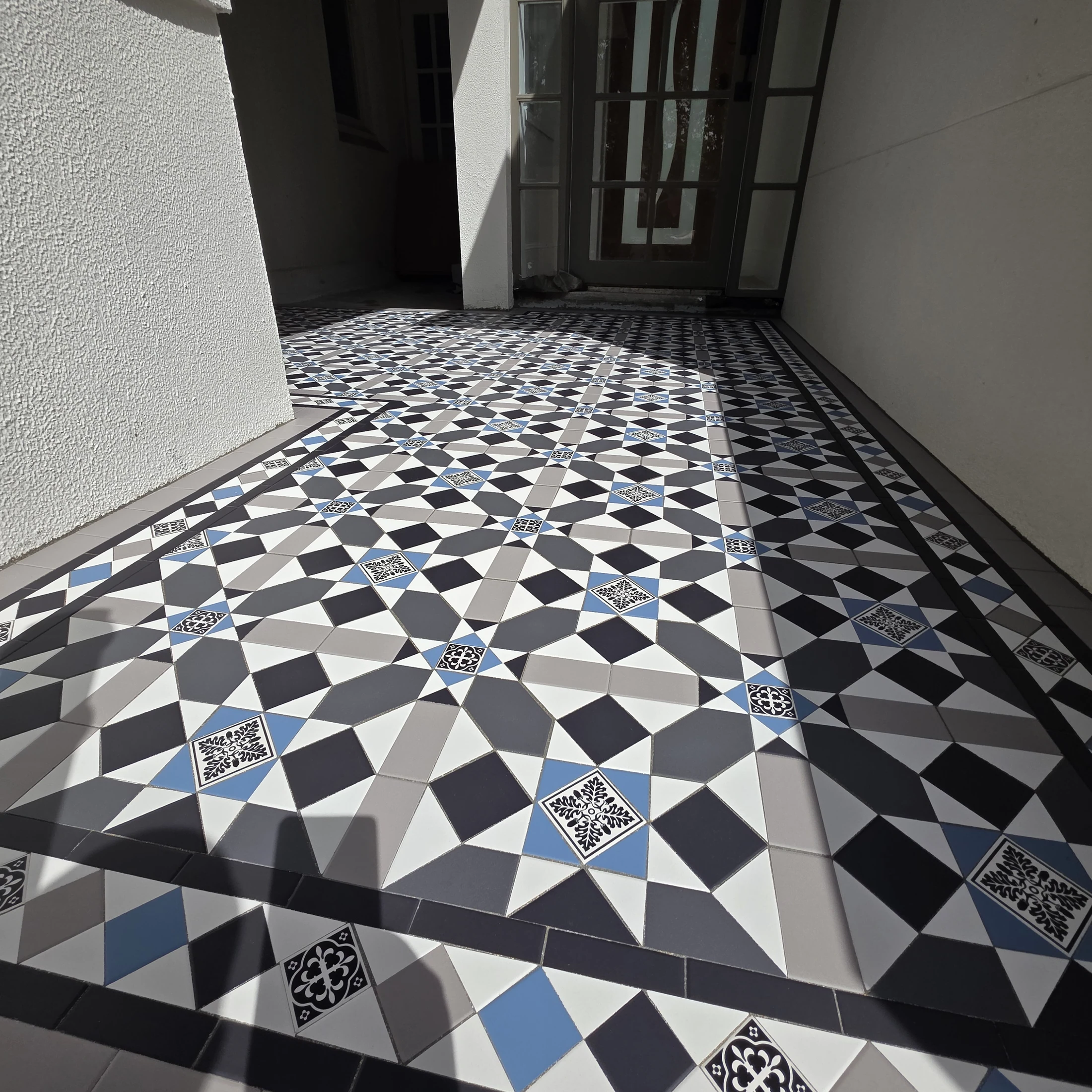
A streetscape where small details matter
The City of Sydney describes Millers Point as an intact residential and maritime heritage precinct with fine-grain subdivision, two- to three-storey terraces, pitched roofs and a consistent townscape. Sandstone and other traditional building materials sit alongside a varied collection of architectural styles and street alignments. For tile work, that means colour, border proportions, thresholds and junctions should be considered as part of the whole frontage rather than selected in isolation.
The locality's steep coastal topography is expressed through retaining walls, public staircases, laneways and pedestrian pathways. A site visit or design review should account for how a tiled surface meets steps, edges, drainage points and existing masonry, without assuming that one construction detail suits every property.
Sydney Development Control Plan 2012 — Section 2 Locality StatementsCity of Sydney: Statements of Significance for Millers Point
Start with the property, not a generic period label
Millers Point contains layers of residential, commercial and maritime fabric. A useful tile design can draw inspiration from the building's scale, entry sequence, existing stonework and the way the frontage is seen from the street. A measured layout and restrained palette may be more appropriate than treating every terrace or pathway as interchangeable.
Where original or early fabric survives, document it before removing or covering anything. NSW guidance for the precinct stresses that significant early stone or brick masonry should not be irreversibly lost and that historic layouts should remain understandable. Tile supply and installation decisions should therefore follow an assessment of what is present, what is damaged and what must remain legible.
Millers Point & Dawes Point Village Precinct: General Design Guidelines for Adaptive Reuse of Heritage PropertiesSydney Development Control Plan 2012 — Section 2 Locality StatementsCity of Sydney: Statements of Significance for Millers Point
Plan installation and restoration around access and existing fabric
Millers Point's narrow streets, steps and varied levels make access, sequencing and protection of adjoining surfaces important planning questions. Design consultation can establish the intended pattern and edge treatment before supply and installation are coordinated. Stone bullnose or edging coordination may be relevant where a tiled surface meets a step, landing or other hard edge, subject to the individual site.
For restoration work, the first question is whether tiles, bedding, edges or adjoining masonry can be retained and repaired. Matching should be based on the surviving surface and the visual relationship to the property, not on an assumed uniform Millers Point pattern. A heritage listing or conservation-area context does not mean that AHTC provides approval; owners should confirm property-specific requirements with the relevant council or NSW heritage authority.
Sydney Development Control Plan 2012 — Section 2 Locality StatementsMillers Point & Dawes Point Village Precinct: General Design Guidelines for Adaptive Reuse of Heritage PropertiesNSW Planning Portal: Millers Point Heritage Conservation Area
Craftsmanship that respects the public face of the place
The official statements of significance describe Millers Point as a living cultural landscape whose streets, lanes, steps, fences, rock cuttings, views and low-rise form contribute to its character. Good tessellated tiling should sit comfortably within that setting: lines should be resolved at thresholds, edges should be intentional, and new work should not visually overwhelm the building or its neighbours.
If a verandah or balcony is already enclosed, the design discussion should distinguish repair from a new enclosure. NSW guidance generally discourages enclosing open verandahs and balconies because of the effect on the historic streetscape. Tile work can support a broader property-led upgrade, but it should not be presented as a substitute for heritage assessment or planning advice.
City of Sydney: Statements of Significance for Millers PointMillers Point & Dawes Point Village Precinct: General Design Guidelines for Adaptive Reuse of Heritage Properties
A practical next step
Share the locality, the type of surface and any photographs or drawings available for the property. The design conversation can then focus on whether the brief is new tessellated tile supply and installation, a verandah or pathway layout, or assessment and restoration of an existing surface. Where the work sits within a heritage conservation area or affects significant fabric, allow time to confirm the relevant property controls before work begins.
For broader Sydney service navigation, use the City of Sydney location directory and the existing Sydney tessellated-tile and heritage-restoration service pages. This Millers Point page remains the local entry point and does not replace those technical service owners.
Sydney Development Control Plan 2012 — Section 2 Locality StatementsNSW Planning Portal: Millers Point Heritage Conservation Area
Your Heritage Tiling Questions
Does every Millers Point property have the same heritage controls?
No. Official material distinguishes the Millers Point Heritage Conservation Area, the larger Millers Point and Dawes Point Village Precinct and individual heritage items. The relevant controls depend on the property and the proposed work, so confirm them with the City of Sydney or the applicable NSW heritage authority before starting.
What should be considered before installing tessellated tiles in a Millers Point terrace or pathway?
Consider the existing building fabric, the relationship to sandstone and other traditional materials, the fine-grain frontage, thresholds, steps, drainage and access. A measured design review can help resolve the pattern and edges before supply and installation are coordinated.
Can existing tessellated tiles be restored rather than replaced?
That depends on the condition of the tiles, bedding, edges and adjoining fabric. Start with an assessment of what survives and what can be retained. NSW guidance for the precinct emphasises avoiding irreversible loss of significant masonry and keeping historic layouts legible; a site-specific assessment is more reliable than assuming replacement is required.
Can new tiles be added to an open verandah or balcony?
Tile work should be considered with the whole verandah or balcony design. NSW guidance generally discourages enclosing open verandahs and balconies because of their effect on the historic streetscape, while repair of existing enclosures may be acceptable. Confirm the property's requirements before changing the form of the space.
Does AHTC provide heritage approvals for Millers Point work?
No. AHTC can discuss tile design, supply, installation and restoration coordination, but heritage or planning approvals are property-specific matters for the relevant authority. The heritage context should be checked before work begins.
Discuss Your Heritage Tiling Project
Share your location, project details and photographs using our enquiry form, or call 0433 932 711.