
Tessellated tiles and heritage-sensitive tiling in Pakenham
Pakenham combines an established town centre and older residential streets with ongoing growth across Melbourne's south-east. For a verandah, path, entry or interior floor, a considered tile layout should respond to the building's proportions, the existing fabric and the way the property is used. AHTC provides design consultation, tessellated tile supply, installation, restoration and stone bullnose or edging coordination for Pakenham projects.
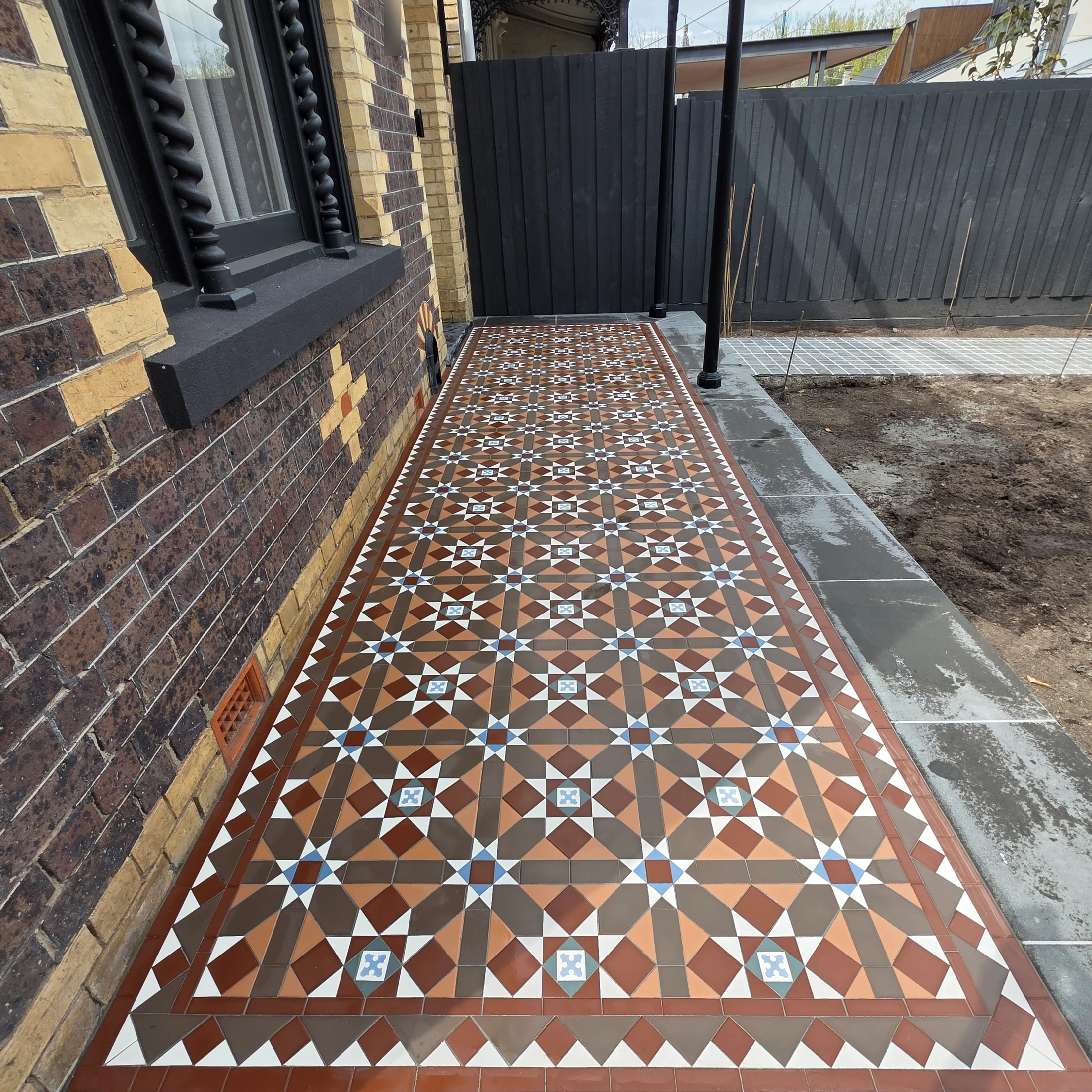
A Pakenham context that varies from street to street
Pakenham is part of Cardinia Shire and the Casey-Cardinia South-east Growth Corridor of metropolitan Melbourne. That combination of established urban areas and continuing growth means a new tiled surface may sit beside an older home, a renovated period property or a newer build. The right response is not a generic period label; it is a review of the building, the threshold, the adjoining surfaces and the intended use.
For older houses, the proportions of a verandah or entry can guide border widths, field scale and transitions. For newer work, tessellated tiles can still be used deliberately, with a restrained palette and a layout that relates to the facade rather than imitating an unverified historical scheme. Design consultation can help resolve those choices before supply and installation are scheduled.
Working carefully around documented local character
Cardinia's Pakenham heritage review records local-significance precincts including St James' Village, Henty Street and James Street. It describes a mix of interwar and post-war residential forms, including weatherboard, fibro-cement and brick houses. Those findings are useful design context, but they do not make every Pakenham property heritage-listed.
Where a property sits within a heritage overlay or another planning control may apply, the owner should confirm the current requirements with the relevant authority before work begins. AHTC can keep the tiling discussion focused on retaining sound existing fabric, matching or complementing established details where appropriate, and separating repair decisions from new installation decisions.
Plan the surface, edges and transitions together
Tessellated layouts are read at the edges as much as in the central field. On a Pakenham verandah or pathway, the design should account for the approach, steps, door thresholds, drainage exposure and the relationship with adjacent paving or garden areas. A border, corner treatment or stone bullnose edge should be selected as part of the overall composition rather than added as an afterthought.
For restoration, the first question is what can be retained. Existing tiles, bedding and adjoining finishes need to be assessed on site before a repair or replacement approach is chosen. For new work, supply and installation can be coordinated around the approved layout, site conditions and access sequence rather than assuming one construction method suits every property.
Tiling services for Pakenham properties
AHTC's Pakenham service includes design consultation for pattern, proportion and material selection; tessellated tile supply; installation planning; restoration of existing tessellated surfaces; and coordination of stone bullnose or edging details. The suitable scope depends on the property and the surface condition, so an enquiry should describe whether the work is new, restorative or a mixture of both.
Photographs and basic dimensions can help begin the conversation, followed by a more specific review of the proposed area, access and adjoining finishes. Where a planning or heritage check is relevant, that should be treated as a property-specific step rather than assumed from the suburb name alone.
Your Heritage Tiling Questions
Is every older Pakenham home heritage-listed?
No. The Pakenham heritage review identifies particular precincts and places of local significance, not a suburb-wide heritage designation. If your property may be affected by a Heritage Overlay or another planning control, confirm its current status with the relevant authority before work begins.
Can tessellated tiles suit a newer Pakenham extension?
Yes, if the layout is designed for the building rather than treated as a generic period feature. Scale, border proportion, thresholds, adjoining paving and the facade's materials should be considered together so the new surface feels intentional.
What should be considered for a Pakenham verandah or pathway?
Consider the approach, steps, drainage exposure, door thresholds, edge details and the transition to surrounding paving or garden areas. These practical conditions influence the layout and the choice of border or stone bullnose finish.
Can existing tessellated tiles be restored rather than replaced?
Often the first step is an on-site assessment of the existing tiles, bedding, edges and adjoining finishes. The resulting condition review can distinguish areas suitable for retention and repair from sections that need a carefully coordinated replacement.
Discuss Your Heritage Tiling Project
Share your location, project details and photographs using our enquiry form, or call 0433 932 711.