
Tessellated Tiles in Endeavour Hills
Endeavour Hills is an established Casey suburb where new tiling work benefits from a considered response to the existing house, garden setting and street presentation. Authentic Heritage Tiling Co can help with tessellated tile design, supply, installation and restoration, including verandahs, entry paths and other areas where pattern and proportion need to sit comfortably with the property.
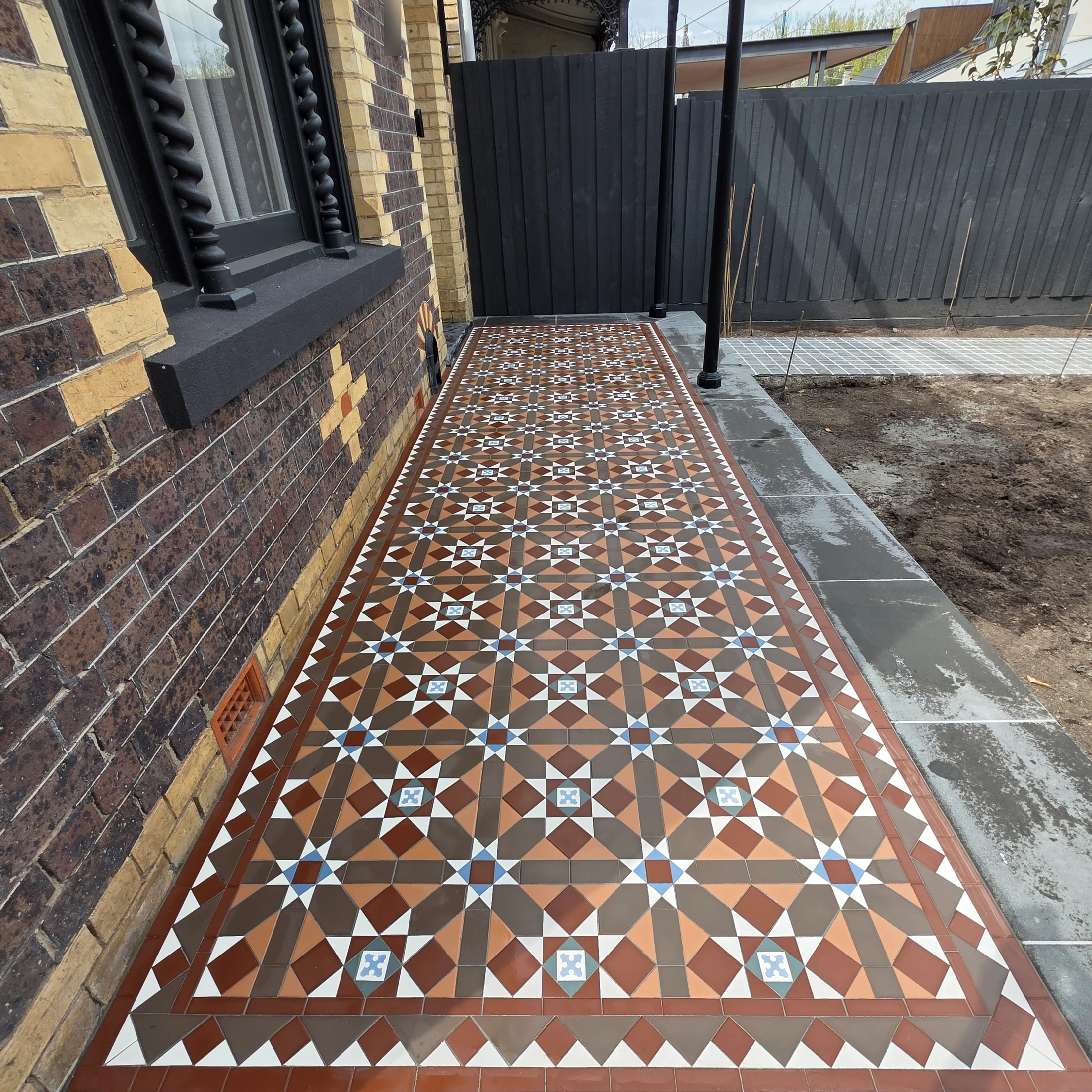
Tiling for an established, green-treed suburban setting
The Casey Planning Scheme describes Endeavour Hills as part of Casey's established urban areas and links those areas with existing services, transport connections and a leafy, green-treed character. That context makes the surrounding landscape and the way a new surface meets the front garden important design considerations. A restrained border, a carefully scaled repeat or a simple transition can often support the house without making the path or verandah compete with it.
This is not a claim that every Endeavour Hills property has the same age or architectural style. The right approach depends on what is already present: the entry geometry, roof and façade proportions, retained paving, garden edges, drainage and the condition of any original tiles. A property-specific review is more useful than assuming a period pattern from the suburb name alone.
Plan the pattern around the way the space is used
For an Endeavour Hills verandah or front path, begin with the measured width, turning points, thresholds and sightlines from the street. Tessellated layouts can define a narrow approach, frame a porch or create a clear change between an entry landing and the garden. Border width, corner treatment and the position of cuts should be resolved before ordering so the pattern feels intentional at both walking distance and from the street.
Where an existing surface is being altered, the design conversation should include what can be retained, what needs careful removal and how the new work will meet doors, steps and adjoining paving. Supply, installation and restoration are related but different tasks; the suitable sequence depends on the actual substrate and surviving fabric rather than a universal recipe.
Consider access, edges and local planning context
Endeavour Hills is also identified in the Casey Planning Scheme as a Major Activity Centre. For a home or small property project near a busier retail or community setting, access, pedestrian movement, frontage transitions and the relationship between private paving and the public edge may need more attention than a secluded rear terrace. These are design and coordination questions, not a blanket statement about permits or heritage controls.
Before work begins, check the property-specific requirements with the relevant authority or a qualified building and planning professional where the scope affects a listed place, an overlay, a shared boundary, drainage or public-facing works. Tile design advice does not replace that check.
Design, supply, installation and restoration
AHTC's service can be tailored to the condition and role of the space. Design consultation can develop a pattern and edging approach; tessellated tile supply can be coordinated with the selected layout; installation can be planned around the site's access and junctions; and restoration can focus on assessing and retaining suitable existing work. Stone bullnose or edging coordination can also be considered where the edge detail needs to connect with steps or adjoining surfaces.
The useful starting point is a clear description of the property and the work area, supported by photographs and dimensions where available. That allows the design conversation to focus on the actual pattern, transitions and condition rather than a generic suburb template.
Your Heritage Tiling Questions
Can tessellated tiles suit a newer Endeavour Hills home?
Yes, if the pattern, scale, colour balance and edge detail are designed for the building and its landscape. Endeavour Hills includes established and changing residential areas, so the house itself should guide the selection rather than assuming a heritage pattern is required.
What should I consider for an Endeavour Hills front path?
Measure the path width, changes in direction, steps, thresholds and drainage points first. Then consider how the border, repeat and transitions will read from the street and how the paving will meet the garden and existing surfaces.
Can existing tessellated tiles be restored rather than replaced?
Often the first step is an assessment of what remains, including loose or damaged areas, previous repairs, edges and the surface beneath. A restoration approach can then be weighed against selective replacement or a new adjoining section.
Will I need council approval for tiling work in Endeavour Hills?
That depends on the property and the scope. If the work may involve a heritage register or overlay, structural changes, drainage, a shared boundary or a public-facing edge, obtain property-specific advice from the relevant authority or a qualified professional before proceeding. The suburb name alone does not determine the answer.
Discuss Your Heritage Tiling Project
Share your location, project details and photographs using our enquiry form, or call 0433 932 711.