
Tessellated tiles and heritage tiling in Clyde North
Clyde North is a growing residential area in Melbourne's south-east, shaped by a planned precinct, new streets and the Cardinia Creek edge. Tile design still needs to respond to the individual property: a contemporary entrance, verandah or pathway calls for different decisions from the careful repair of an older place. We provide design consultation, tessellated tile supply, installation, restoration and stone bullnose or edging coordination for Clyde North properties, subject to the site's condition and requirements.
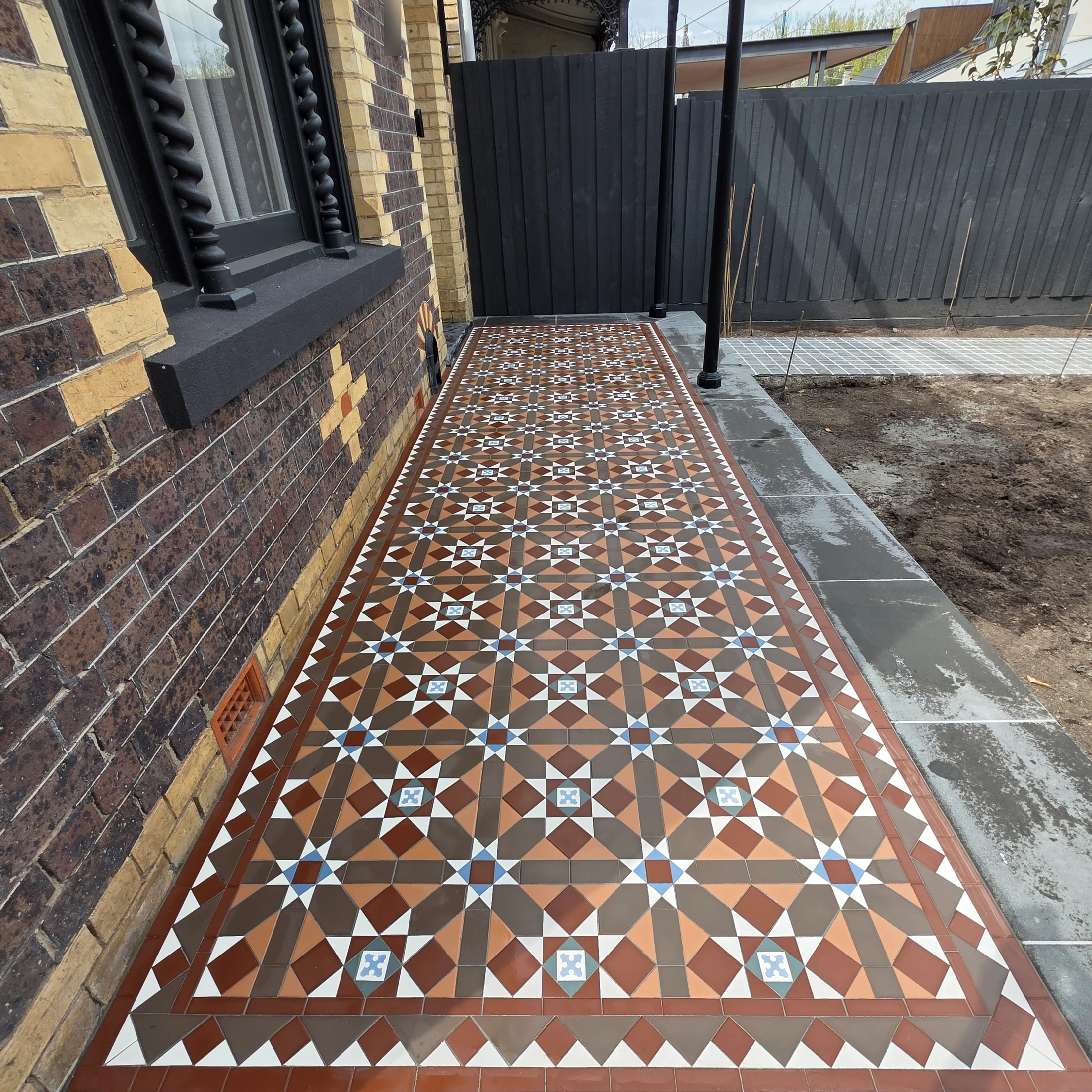
A planned growth setting with room for considered design
Casey describes Clyde North as a predominantly residential precinct planned around homes, schools, community facilities, local services and open-space connections. In a developing neighbourhood, a tiled entry or path can give a new home a clear point of arrival without pretending that every property shares an older architectural history.
For a new verandah, porch or pathway, begin with the building's proportions, frontage, threshold levels and landscape plan. A border, repeat and edging detail should be scaled to the available width and coordinated with steps, drainage, paving and planting. The most convincing result is one that belongs to the house and its approach rather than a pattern selected in isolation.
Plan the tiled surface around the site
The Clyde North planning scheme contains provisions for relevant small lots, building envelopes and subdivision design responses. Those planning provisions do not prescribe a universal tile layout or installation method, but they reinforce the value of checking the approved plans, available space, levels and access before finalising a tiled area.
On a compact frontage, the relationship between the door, steps, fence, driveway and footpath can be especially visible. Design consultation can test the field size, border width and transitions before supply and installation. Where a stone bullnose or other edging is being considered, it should be coordinated with the actual edge condition and levels rather than assumed to suit every site.
Respond to the Cardinia Creek setting
The Cardinia Creek Conservation Corridor forms the eastern boundary of the Clyde North precinct. A property near open space or a waterway edge may have a stronger relationship with drainage, landscape, vegetation and transitions between private and public areas. These conditions are design considerations, not a reason to assume that every home has the same environmental or approval requirements.
Before work begins, review the property's current planning information and any applicable conditions with the relevant authority. A tiled surface should be designed to meet the actual thresholds, falls and adjoining landscape, while existing fabric should be assessed before it is removed or covered.
Older places need a property-specific heritage check
Clyde North's growth setting does not mean that its entire housing stock has one architectural period. Casey highlights Eyrecourt as a heritage place in Clyde North, and the Victorian Heritage Database records that individual place as a locally significant Victorian farmhouse within a Casey Heritage Overlay. That is a specific heritage example, not evidence that every Clyde North property is listed.
If an older home or existing tiled verandah is involved, document the surviving tiles, thresholds, steps, edging and adjoining masonry before choosing repair or replacement. Check the individual address through the relevant Victorian and Casey heritage resources, and confirm any planning or heritage requirements before work. AHTC can discuss restoration and matching options, but does not provide council approval or heritage certification.
Tessellated tile services for Clyde North properties
The same local route can support several property-led needs: developing a tessellated design for a new entrance, coordinating supply and installation for a verandah or pathway, or assessing existing tiles for selective restoration. The right sequence depends on the surface, access, levels, adjoining materials and the intended character of the property.
Begin with the design and condition conversation, then resolve the tile pattern, colour balance, border, transitions and edging before the work is scheduled. This keeps the local page useful for both new residential work and careful renewal without creating a second page that repeats the same service intent.
Your Heritage Tiling Questions
Is every Clyde North property heritage-listed?
No. Casey identifies particular heritage places, including Eyrecourt, and the Victorian Heritage Database records individual places and their specific controls. Heritage status must be checked for the particular address; the existence of one listed place does not apply the same controls to every home in Clyde North.
What should I consider when planning tessellated tiles for a new Clyde North entrance?
Start with the frontage width, door and step geometry, approved levels, adjoining driveway or paving, landscape edges and how the entrance is seen from the street. Then develop the pattern, border and edging at a scale that suits the actual property rather than assuming a historic layout is appropriate for every new home.
Does the Clyde North planning scheme prescribe a tile installation method?
The planning scheme contains precinct, subdivision, housing-design, site-context, waterway and environmental requirements, but it does not establish one universal tessellated-tile method for every property. Confirm the applicable planning and building requirements for the site, then assess the existing surface, levels and interfaces before selecting an installation approach.
Can existing tiles be restored in an older Clyde North property?
Restoration can be considered after the surviving tiles, substrate, thresholds, edges and adjoining materials have been assessed. If the property may be heritage-listed or affected by a Heritage Overlay, check the individual address and proposed scope with the relevant authority before removing, replacing or altering fabric.
Is Clyde North treated as a regional Victorian location?
No. Clyde North is treated here as part of metropolitan Melbourne's southern growth corridor. Its local page remains connected to the Casey service directory, while broader Melbourne service guidance can be used for related design, supply, installation and restoration information.
Discuss Your Heritage Tiling Project
Share your location, project details and photographs using our enquiry form, or call 0433 932 711.