
Tessellated tiles and heritage tiling in Glenwood
Glenwood combines established residential streets with a documented local history that reaches back to orchards, grazing and Glenwood Park House. For a new pathway, verandah or entrance, the most useful design response begins with the individual property: its frontage, thresholds, existing materials, levels and the way the work will meet the garden or street. AHTC can assist with design consultation, tessellated tile supply, installation, restoration and stone bullnose or edging coordination.
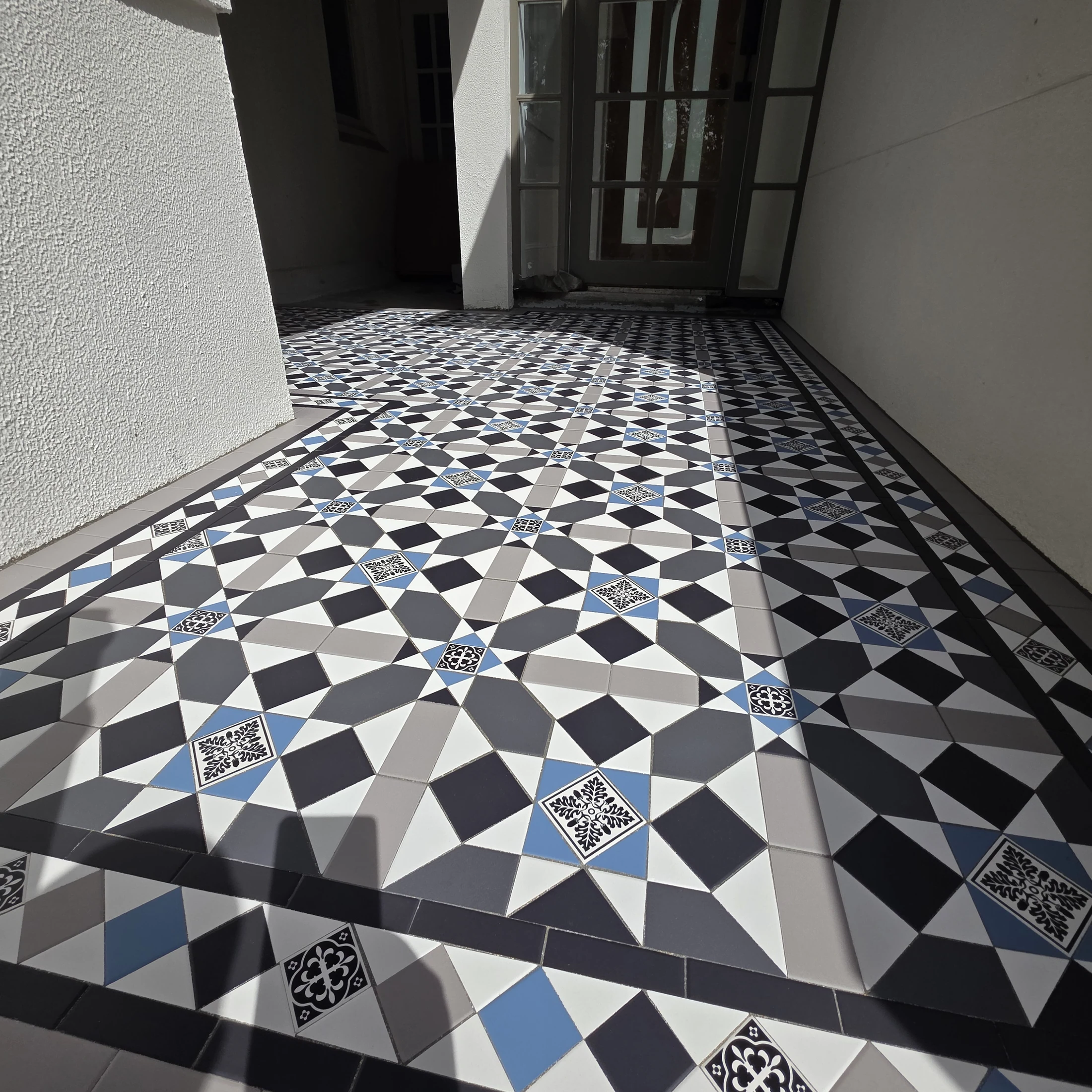
A Glenwood setting with a specific historic reference point
Blacktown City Council records Glenwood's name as a link to the historic property Glenwood Park House, formerly known as Norfolk Vale and Sorrento before Glenwood Park was adopted. That history gives the suburb a useful local reference, but it does not mean every home shares the form or age of the homestead.
The council's account of Glenwood House describes a brick two-storey building with a front verandah, iron lacework, marble fireplaces and detailed plasterwork. These details can help a property owner think about proportion, edge treatment and the relationship between a tiled surface and adjoining masonry, without copying a historic building or assuming a universal Glenwood style.
Choose a layout for the frontage, not a suburb label
A Glenwood entrance or verandah should be assessed at its actual dimensions. Border width, field pattern, steps, doors and sightlines can change how a design reads from the footpath and from inside the home. Existing brickwork, render, painted joinery or stone can provide a more reliable palette cue than a broad period assumption.
For pathways, the transition to the garden, driveway or street edge deserves the same attention as the tile pattern. Levels, falls, drainage and movement at thresholds should be considered during site assessment; there is no single substrate detail or installation method that suits every property.
Check the individual property before heritage-sensitive work
Glenwood House is a specific historic place, not evidence that all Glenwood residences are heritage-listed. If a property includes older tiles, original steps or other fabric that may be significant, document what remains before removal and consider whether retention, selective repair or complementary new work is the better fit.
Planning controls can change and may differ between properties. NSW Planning records that Glenwood was removed from the Bella Vista and Kellyville rezoning, so current site-specific planning information should be checked before work proceeds. Design guidance for a tile project is not council approval or heritage-authority endorsement.
Coordinate supply, installation and restoration carefully
Design consultation can establish a pattern, border and colour relationship that suits the frontage. Supply and installation then need to follow the measured site and the condition of the underlying area. Where existing tiles survive, restoration begins with understanding their pattern, condition and extent rather than assuming replacement is necessary.
Stone bullnose or edging can be coordinated where a defined boundary is part of the design. The edge at a step, verandah post, garden line or wall often determines whether the finished work feels integrated with the house.
Your Heritage Tiling Questions
Does every Glenwood property have the same heritage status?
No. Glenwood House is a documented historic place, but its presence does not establish that every Glenwood home is listed or subject to the same controls. Check the current property-specific planning and heritage information before deciding how to alter an older surface.
What can Glenwood House contribute to a tile design conversation?
Its documented brick construction, front verandah, iron lacework, marble fireplaces and detailed plasterwork can act as context cues for proportion, edge treatment and material relationships. They are references for discussion, not a requirement to reproduce the homestead or a claim about every Glenwood property.
Can tessellated tiles suit a newer Glenwood home?
They can be considered where the pattern, scale and detailing suit the home's frontage. The design should be based on the actual entry, verandah or pathway, including levels, thresholds, adjoining materials and the owner's brief rather than on the suburb name alone.
Should I check planning information before changing tiles in Glenwood?
Yes. The relevant pathway depends on the property and proposed work. NSW Planning records that Glenwood was removed from the Bella Vista and Kellyville rezoning, so do not assume that nearby precinct changes apply; check current site-specific planning information before proceeding.
Can an existing Glenwood tiled surface be restored instead of replaced?
An assessment can consider whether surviving tiles and related fabric are suitable for retention, selective repair, matching or complementary new work. The right choice depends on condition, pattern, significance and the practical needs of the property.
Discuss Your Heritage Tiling Project
Share your location, project details and photographs using our enquiry form, or call 0433 932 711.