
Tessellated Tiles in Albert Park
Albert Park's streetscapes bring together Victorian and Edwardian-era housing, attached and row homes, and later 1930s and 1940s architecture. For a verandah, entry, hallway or pathway, a tessellated tile scheme works best when its proportions, border treatment and colour balance respond to the building rather than imitate a period label. Authentic Heritage Tiling Co. can help with design consultation, tessellated tile supply, installation, restoration and stone bullnose or edging coordination for properties in Albert Park and the surrounding Port Phillip area.
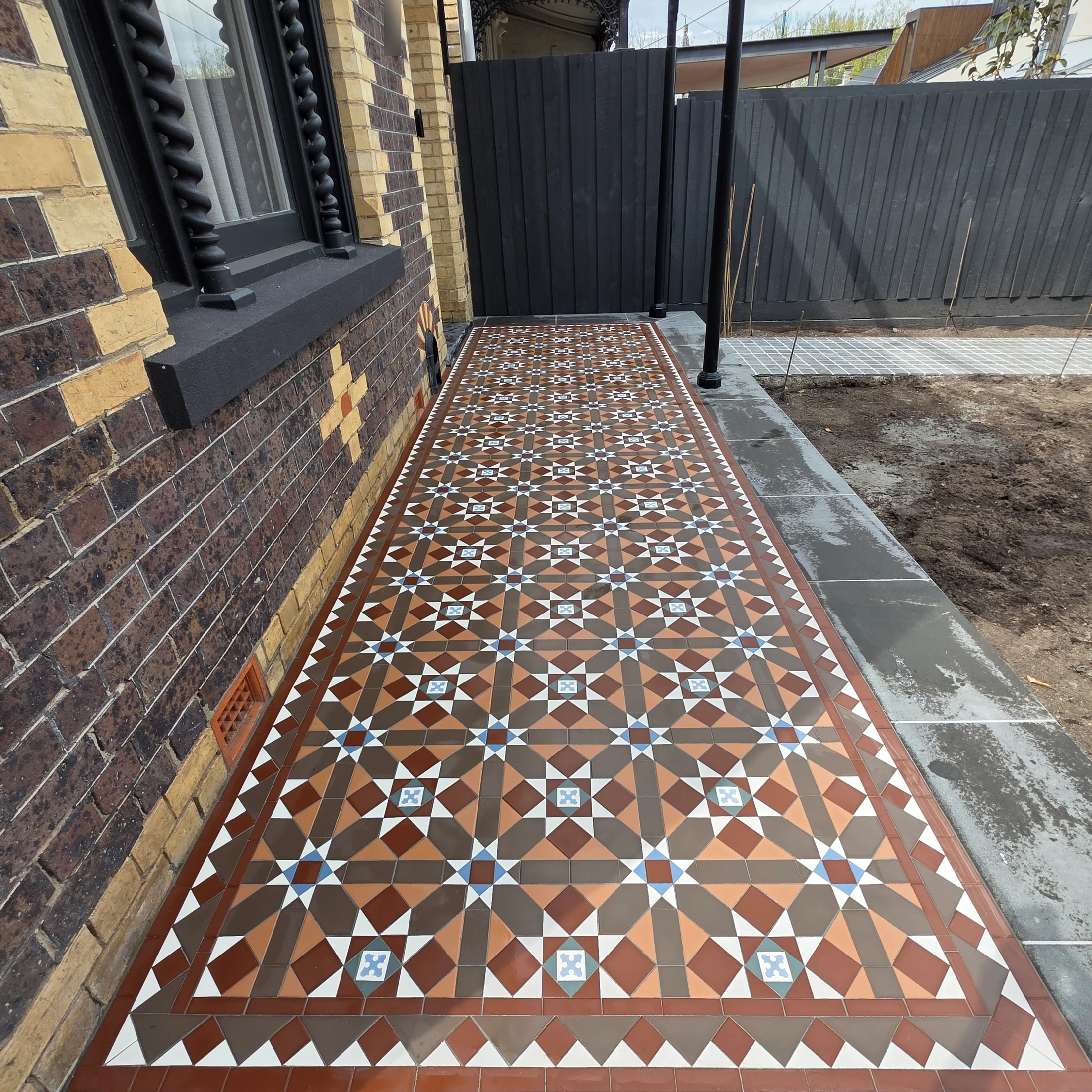
Designing for Albert Park's streetscape
The City of Port Phillip describes Albert Park and nearby Middle Park as a historic neighbourhood with leafy streets, attached and row housing, and buildings from Victorian and Edwardian periods alongside notable 1930s and 1940s architecture. That mix makes a measured design consultation more useful than a one-size-fits-all pattern: a restrained border may suit one frontage, while a stronger geometric field may belong in a later home or a clearly defined new pathway.
For a front verandah or entrance, consider the relationship between the tile module, threshold levels, steps, door swing and existing masonry. For a garden path, review the path width, turning points, edge finish and transitions before selecting a repeat. Tessellated supply and installation can then be coordinated with the intended layout rather than treating pattern as an afterthought.
Heritage context is property-specific
Albert Park's architectural context includes individually recognised places. The Victorian Heritage Database describes the local primary school as incorporating an 1874 Gothic building and an 1890 Wesleyan church, and records the railway station complex as an 1888–1889 Italianate pair of polychromatic-brick buildings. These places show why scale, brickwork, thresholds and surviving details can matter when planning tile work nearby, but they do not establish a uniform style for every home.
The Port Phillip Heritage Review and Heritage Overlay schedule should be checked for the particular property before work is specified. Controls can vary between places and may address external paint, internal alterations, trees or other matters. A tile consultation can help identify what is existing, what is proposed and what should be confirmed with the relevant planning authority; it does not replace property-specific heritage or planning advice.
Restoration, replacement and new tessellated work
Where original tiles remain, begin with an assessment of their condition, pattern, edges and transitions. A restoration approach may focus on retaining sound fabric and making carefully matched repairs. Where a new floor or path is planned, the design can be developed around the building's scale and the practical demands of the site. Supply, installation and stone bullnose or edging coordination can be considered together so the finish reads as a resolved part of the property.
Photographs and dimensions of the area are useful starting information for a design discussion. If a property is affected by a Heritage Overlay or is a registered place, confirm the applicable requirements before construction decisions are finalised.
Your Heritage Tiling Questions
Are all Albert Park homes heritage protected?
No. Albert Park has documented historic and architectural character, but heritage status is property-specific. The Port Phillip Heritage Review and planning-scheme maps distinguish different categories of places, so check the particular property rather than assuming the whole suburb has the same controls.
Can tessellated tiles suit a later Albert Park house?
They can, when the pattern, scale, border and transitions are designed for the building. Albert Park includes Victorian and Edwardian housing as well as notable 1930s and 1940s architecture, so a consultation should respond to the actual frontage and proposed use rather than apply one period formula.
What should I check before tiling a heritage property in Albert Park?
First identify whether the property or associated land is covered by a Heritage Overlay or another heritage register entry. The applicable controls vary by place and can include different requirements for external work or alterations, so confirm the relevant planning position before finalising the scope.
Can existing Albert Park tessellated tiles be restored instead of replaced?
An assessment can compare the surviving pattern, soundness, missing areas and edge conditions before deciding between conservation-minded repair, selective replacement or new work. The appropriate choice depends on the tiles and the property, not simply on the suburb name.
Discuss Your Heritage Tiling Project
Share your location, project details and photographs using our enquiry form, or call 0433 932 711.