
Tessellated Tiles in Queenstown, SA
Queenstown's early subdivision and surviving historic buildings make proportion, edge detail and original fabric useful starting points for a tiling decision. Authentic Heritage Tiling Co can help with tessellated tile design consultation, supply, installation and restoration for Queenstown properties, including verandah, pathway and stone bullnose or edging coordination. The right approach depends on the property, the existing surface and the intended use rather than on a suburb-wide assumption.
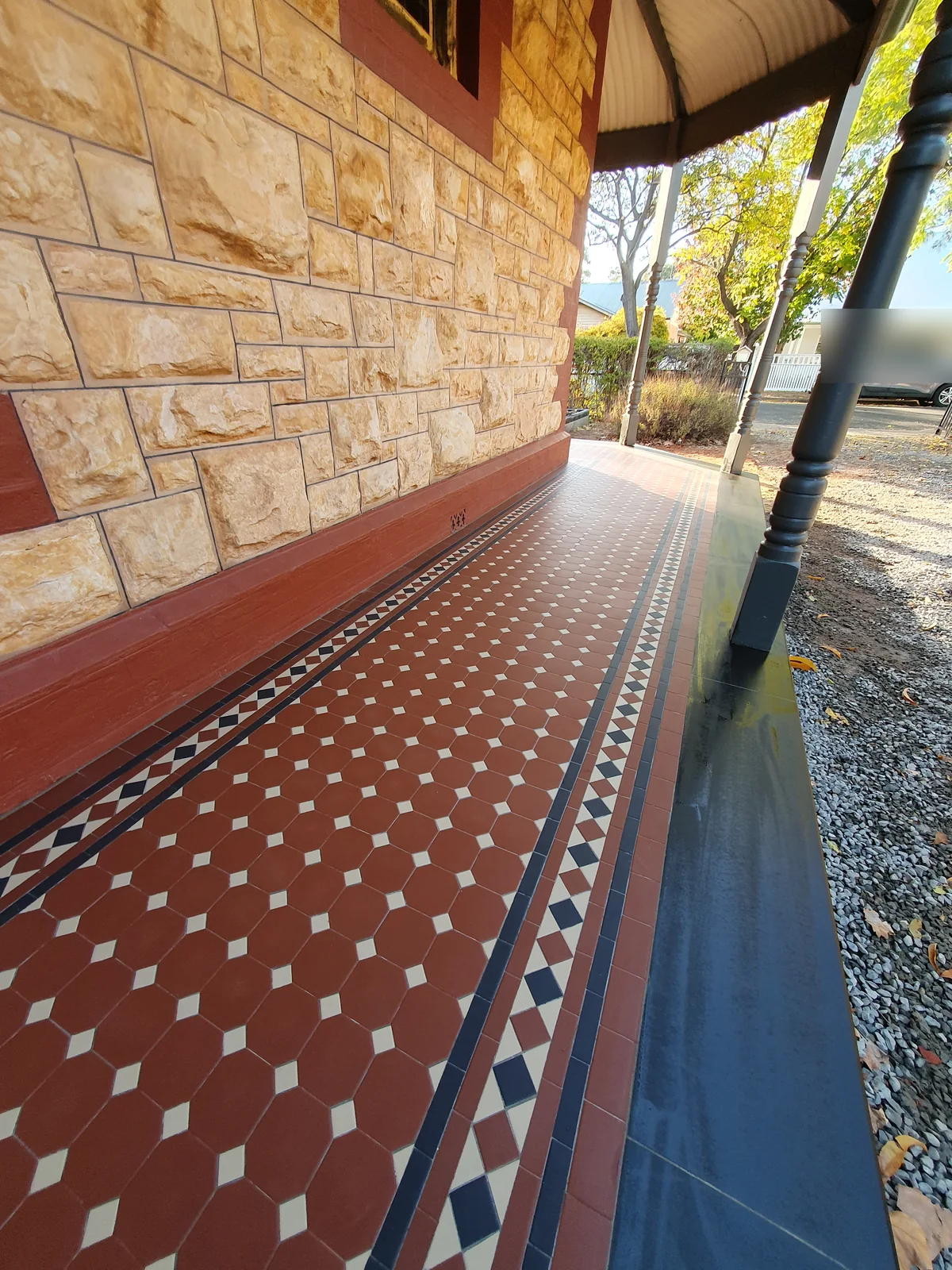
A historic Port Adelaide setting for considered tile design
Queenstown was subdivided under Plan 594 in 1856, and the heritage survey records the District Council of Queenstown from 1864. That history helps explain why some local properties call for a careful relationship between new tiled work and an established frontage, verandah or path.
The official surveys record a mix of individual buildings and representative housing examples rather than a single uniform architectural style. Documented features include brick construction, rendered surfaces, simple verandahs, multipaned windows and narrow doors in an early residence, while other listed examples include civic, commercial and religious buildings. These details can inform a design conversation, but they should not be treated as a template for every Queenstown home.
Plan around the property, not just the postcode
For an older Queenstown property, begin by separating surviving original tilework from later repairs and additions. A measured record of layout, borders, thresholds, levels and damaged areas can make the next choice clearer: retain and repair where practical, match selectively, or introduce new work that sits comfortably beside the existing fabric.
The South Australian Heritage Register includes Queenstown Church of Christ, and local heritage reviews identify other individual places. A listing or heritage character concern belongs to the particular property and proposal. Check the relevant register and council planning information before work that may affect significant external fabric; tiling advice is not heritage approval.
Tessellated tile services for verandahs, paths and floors
A design consultation can address pattern scale, border transitions, colour balance and the way a tiled surface meets brickwork, render, steps or a garden edge. For a verandah or pathway, circulation, falls, drainage exposure and thresholds should be considered alongside the visual pattern.
Where existing tessellated tiles remain, restoration may involve documenting the pattern, identifying sound and failed areas, and coordinating sympathetic replacement or repair choices. New supply and installation can be planned as a separate intervention when the existing fabric is not suitable for reuse. Stone bullnose or edging coordination can complete a step, landing or pathway detail without forcing one treatment onto every site.
A practical first conversation
Useful starting information includes photographs of the tiled area, approximate dimensions, access conditions and any known history of the property. If there are cracks, loose sections, dampness or uneven thresholds, note them rather than covering them before assessment.
The aim is a design and technical conversation grounded in the actual surface. It can then be clearer whether the next step is restoration, a new tessellated layout, supply coordination, installation planning or a combination of these services.
Your Heritage Tiling Questions
Does a Queenstown property automatically need heritage approval for tessellated tiling?
No. Heritage status and planning requirements depend on the particular property, its listing or character controls, and the proposed work. Queenstown has individually documented heritage places, so check the relevant South Australian and council records before altering significant external fabric. A tiling consultation can help identify questions for the appropriate authority, but it is not an approval.
Can an older Queenstown verandah or pathway be matched with new tessellated tiles?
Often a considered match can be explored, but the answer depends on what survives, the pattern and dimensions, the condition of the base, and how closely new work needs to relate to existing fabric. Photographs and measured details are useful before selecting a layout or replacement approach.
Should existing Queenstown tessellated tiles be restored or replaced?
That is a site-specific decision. Sound original areas may be worth retaining, while isolated failures, movement, moisture or extensive later alteration may change the practical options. An assessment should distinguish the existing pattern and fabric from the condition of the supporting surface before a restoration or new-installation plan is chosen.
What should I consider when designing a new tiled path or verandah in Queenstown?
Consider the relationship to the building frontage, border and threshold proportions, pedestrian movement, levels, drainage exposure and any adjoining brick, render, steps or stone edging. A new pattern should respond to the property without assuming that one historic treatment suits every Queenstown site.
Discuss Your Heritage Tiling Project
Share your location, project details and photographs using our enquiry form, or call 0433 932 711.