
Tessellated tiles in Moonee Ponds
For Moonee Ponds homes and period streetscapes, a tessellated tile scheme needs to work with the building, the entry sequence and the level of surviving fabric. We can help with design consultation, tile supply, installation, restoration and stone bullnose or edging coordination for verandahs, paths and other suitable areas.
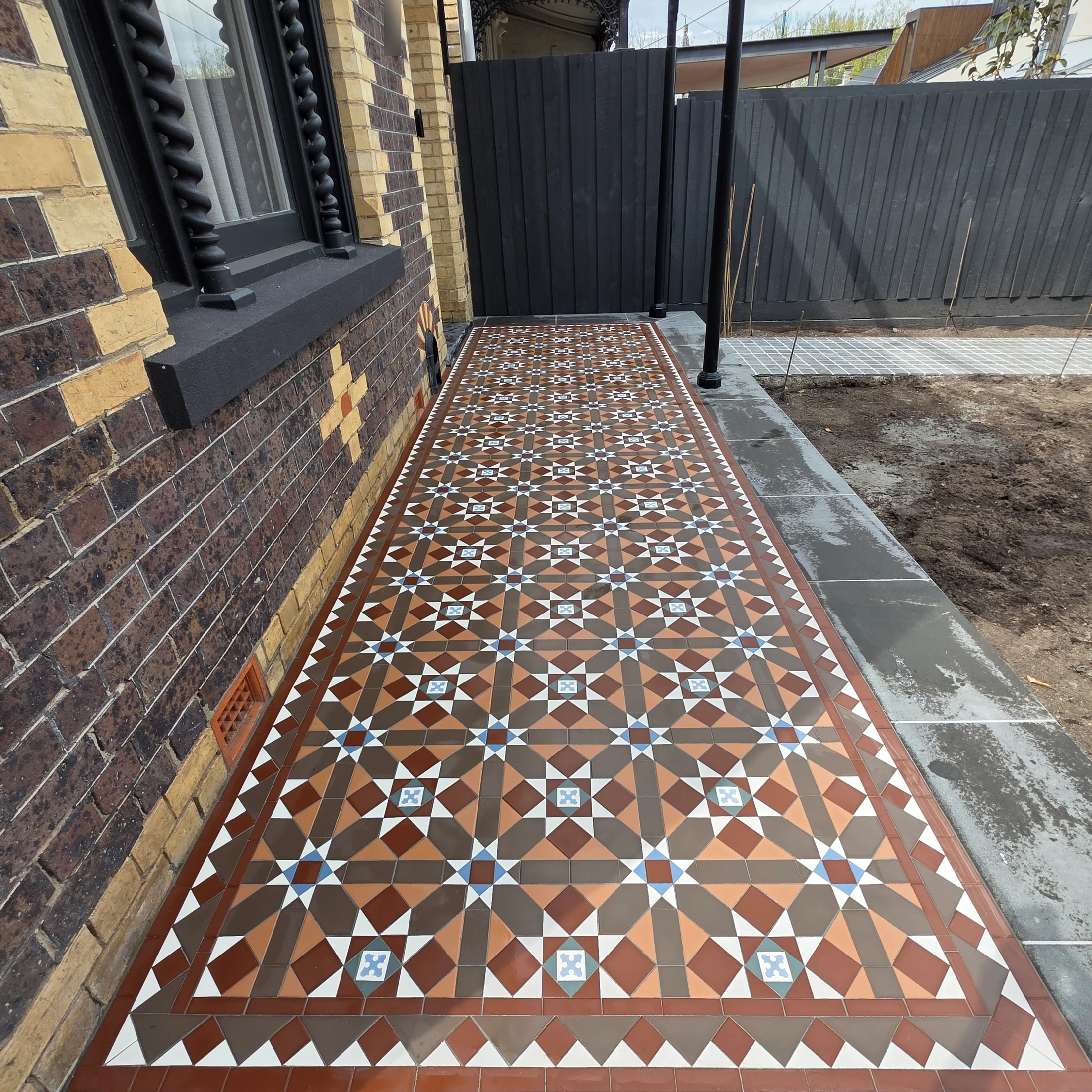
Tiling that responds to Moonee Ponds homes
Moonee Ponds includes documented Victorian-era residential precincts as well as heritage places and public landscapes. In streets such as Grace Street, the heritage study records detached and attached housing, verandahs, brickwork and surviving bluestone street details. These local cues can inform border proportions, colour balance and the relationship between a tiled path and the front elevation without assuming every property has the same history or controls.
A considered design starts with the property in front of you. We look at the existing threshold, steps, verandah geometry, drainage and adjoining materials before discussing a pattern. Where original tiles remain, selective restoration and careful matching may be more appropriate than replacing an entire surface.
Check the property before external tile work
Moonee Valley’s planning information lists heritage places and precincts in Moonee Ponds, and a Heritage Overlay can affect external alterations, demolition, subdivision, construction, trees, fences or paintwork. Before work begins, check the property and the relevant Statement of Significance through the council and Victorian planning resources. Routine repairs that do not change external appearance may be treated differently, but permit requirements are property-specific.
Our role is to discuss a practical tiling approach and coordinate the design, supply, installation or restoration scope. Heritage planning advice and permit decisions remain with the responsible authority and should be confirmed before committing to external changes.
From pattern selection to a finished edge
For a new verandah or pathway, the pattern should be tested against the width, sightlines, steps and transitions rather than selected in isolation. For existing tessellated work, condition assessment can separate sound areas from loose, cracked or missing tiles and help guide a proportionate repair plan.
We can coordinate tessellated tile supply, installation and restoration, along with stone bullnose or edging where the design and site call for it. The final recommendation depends on the existing surface, access, exposure and the way the area meets adjacent paving or garden edges.
Your Heritage Tiling Questions
Do all Moonee Ponds homes need heritage approval for tessellated tiles?
No. Heritage controls are property-specific, and routine repairs that do not change external appearance may be exempt in some cases. Check the property’s overlays and permit exemptions with the City of Moonee Valley and the Victorian planning system before external work.
Can you restore existing tessellated tiles in a Moonee Ponds verandah?
A restoration approach can be considered after reviewing the condition of the existing surface, including loose, cracked, missing or mismatched tiles. The aim is to retain sound original fabric where practical and make any new work sit comfortably with it.
What should be considered when designing a tiled pathway?
Consider the path width, entry alignment, steps, drainage, thresholds and how the border meets adjoining paving or garden edges. A pattern that suits the building and the available proportions is usually more useful than choosing a design without measuring the space.
Can edging or bullnose stone be coordinated with the tile work?
Yes. Stone bullnose or edging coordination can be included where it suits the steps, verandah edge or transition. The appropriate detail depends on the site measurements and the adjoining materials.
Discuss Your Heritage Tiling Project
Share your location, project details and photographs using our enquiry form, or call 0433 932 711.