
Tessellated Tiles Springfield
Springfield's residential identity is tied to a planned prestige estate established in 1928, with later homes adding a mid-century modern strand to the local architectural story. For a verandah, entry, pathway or interior floor, tessellated tile choices work best when the pattern, scale, edges and transitions respond to the house and its setting. We can help with design consultation, tessellated tile supply, installation, restoration and stone bullnose or edging coordination.
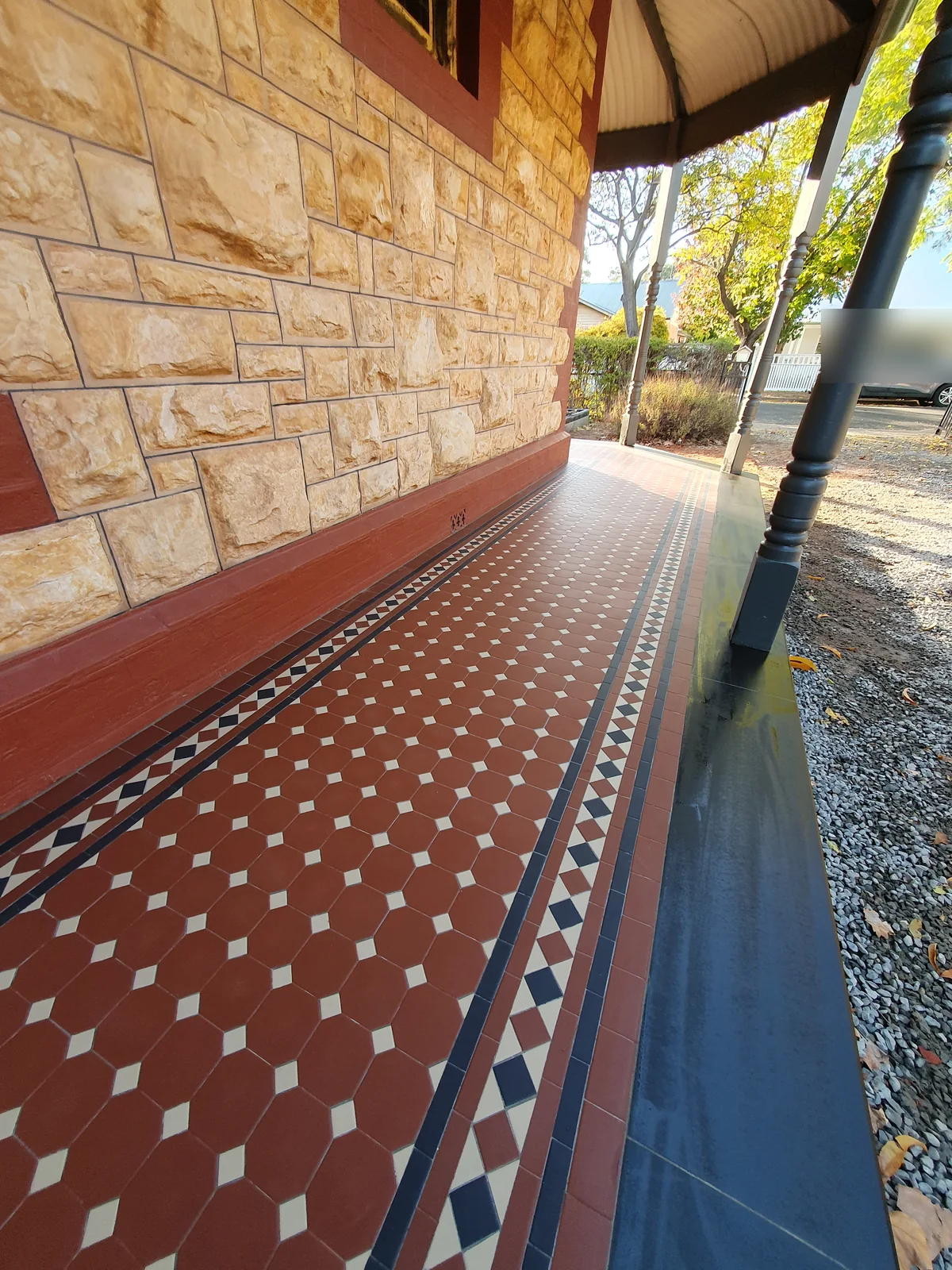
A Springfield setting with more than one architectural period
Springfield Estate was planned as a prestige residential subdivision in 1928. Architectural research traces an evolving mix of early houses and later mid-century modern work rather than a single uniform house type. That makes the existing building, garden setting and approach to the front door important starting points for a tile scheme.
A tessellated pattern can acknowledge an older design language without pretending that every Springfield property has the same heritage status. We look at the proportions of the area being tiled, the relationship between border and field, and whether a restrained or more decorative arrangement will sit comfortably with the building.
Heritage-sensitive decisions are property specific
The Mitcham Heritage Survey records individually assessed places in Springfield, and Carrick Hill is confirmed as a State Heritage Place. Those records are useful reminders to check the particular property and its setting before altering established floors, steps, verandahs or pathways; they do not mean that every home in the suburb is listed.
Where original or early fabric may survive, an assessment can help separate repairable material from later work and guide decisions about matching, selective replacement and new adjoining areas. If a property is heritage-listed or sits within a relevant planning control, the owner should confirm the applicable requirements with the appropriate authority before work begins.
Planning a Springfield verandah, entry or pathway
For a new scheme, start with how people approach and use the space. A front entry may need a clear centreline and durable threshold; a verandah may benefit from a border that follows its posts and steps; a pathway needs proportions and transitions that remain legible as it meets paving, garden edges or existing levels.
Design consultation can cover pattern direction, tile scale, colour relationships and the coordination of stone bullnose or edging. Installation planning should then account for the actual substrate, falls, access and interfaces on site rather than applying one assumed construction method to every Springfield property.
Restoration, supply and installation in one considered process
Existing tessellated floors can require careful inspection before any cleaning, repair or replacement decision. The useful question is not only whether a tile is damaged, but also how the surviving pattern, border, thresholds and surrounding finishes contribute to the room or approach.
For new work, supply and installation can be coordinated around the approved design and the conditions found on site. The same property-led approach applies whether the project is a small entry repair, a verandah extension, a pathway scheme or a broader tiled floor.
Your Heritage Tiling Questions
Does every Springfield home have heritage protection?
No. The Mitcham Heritage Survey identifies individual places for assessment, and the state register confirms particular listed places such as Carrick Hill. Heritage status and planning requirements need to be checked for the specific property rather than inferred from the suburb name.
Can tessellated tiles suit a mid-century Springfield home?
They can, when the pattern, scale, colour and edge treatment are designed for the individual building. Springfield's documented architectural history includes mid-century modern houses as well as earlier residences, so a scheme should respond to the actual home instead of applying a presumed period pattern.
What should be considered for a Springfield verandah or pathway?
Consider the approach, proportions, thresholds, steps, drainage and transitions to adjoining surfaces. A border may need to align with posts or edges, while the field pattern should remain readable through the main walking route. Site conditions should be assessed before installation details are selected.
Can an existing Springfield tessellated floor be restored rather than replaced?
Often the first step is an inspection of the surviving tiles, pattern, borders and surrounding substrate. That assessment can inform selective repair, matching and careful replacement where needed, rather than assuming that a complete removal is the only option.
Discuss Your Heritage Tiling Project
Share your location, project details and photographs using our enquiry form, or call 0433 932 711.