
Manningham heritage tiling area directory
Use this Manningham area directory to find locality-specific heritage tiling guidance. Manningham brings together established residential suburbs, older village histories, former orchard landscapes and the river-valley setting of Warrandyte. Authentic Heritage Tiling Co can help you plan tessellated tile supply, installation or restoration with the property context in mind, whether the work is for a verandah, entry, pathway or interior floor.
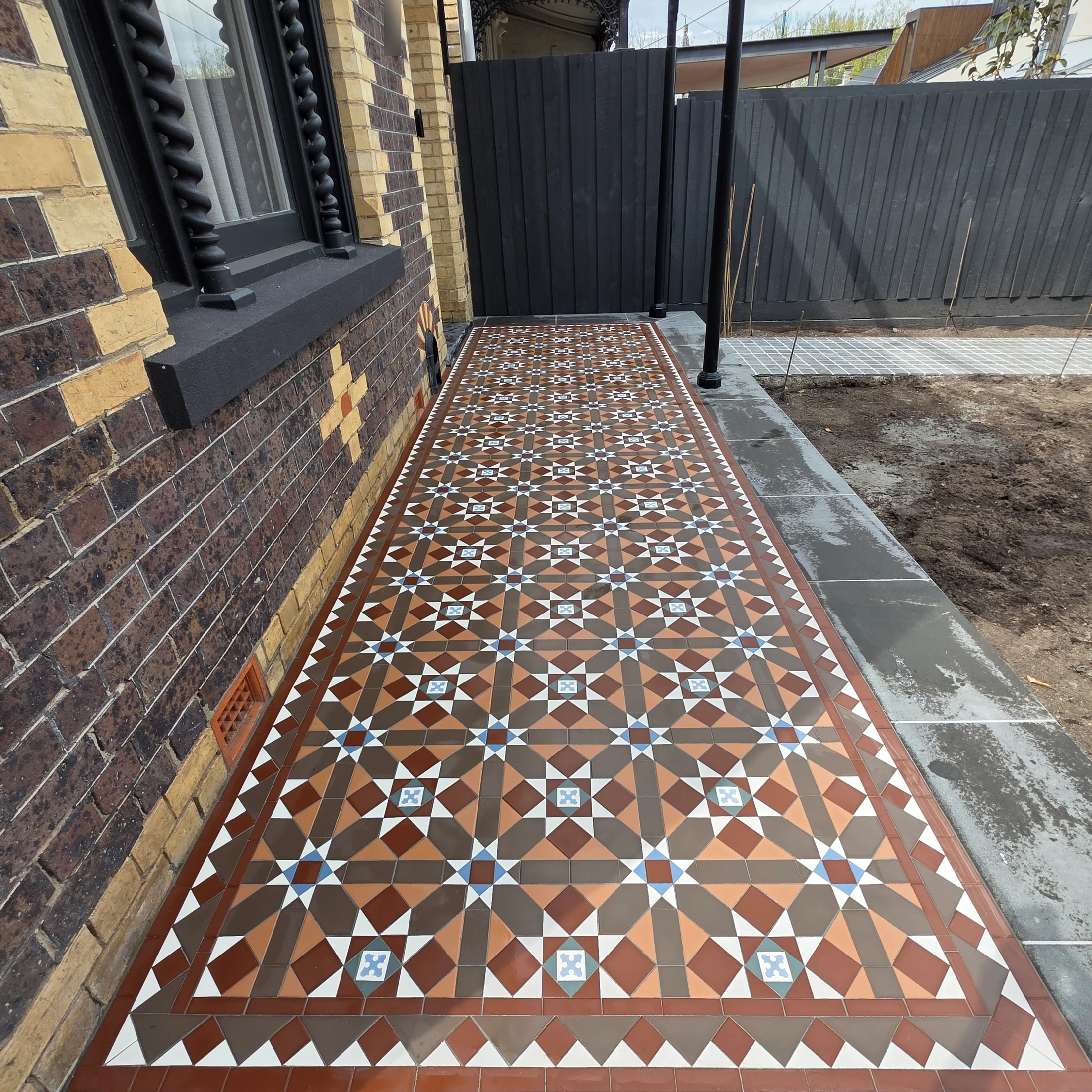
A varied Manningham setting for considered tile work
Manningham is part of Metropolitan Melbourne's Eastern Region. Its local character is not uniform: Council records post-war development in Bulleen, Doncaster East, Donvale and Templestowe Lower, orchard and early-village histories around Doncaster and Templestowe, and the planned 1925 country club estate origins of Park Orchards.
Those differences can inform the feel of a new tiled surface. A restrained border and clear geometry may suit an established suburban entry, while a pathway or verandah near a landscape-led setting needs careful attention to proportion, thresholds, levels and how the work sits within views from the street. The design should respond to the property rather than assume that every Manningham home shares one period or architectural style.
Metropolitan Melbourne regions and local governments — Planning VictoriaDiscover our area, history and demographics — Manningham Council
Designing for verandahs, entries and pathways
Begin with the part of the property the tiles need to support. Verandahs and front entries benefit from a layout that resolves door thresholds, steps and the visual relationship between the house and garden. For pathways, the useful questions are how the route turns, where water is directed, how edges meet adjoining surfaces and whether a border helps the path read clearly without overwhelming it.
In Park Orchards, Doncaster, Templestowe and other established localities, the surrounding garden, frontage and existing building lines can be as important as the tile pattern. We can discuss pattern scale, colour balance, edging and stone bullnose coordination as part of a design-led supply and installation plan.
Discover our area, history and demographics — Manningham Council
Warrandyte: work with landscape, views and existing fabric
Council's Warrandyte township guidelines describe a semi-rural village where buildings are secondary to the landscape. They call attention to views toward the river and treed slopes, stepped siting on hillsides, generous setbacks, paths and stone retaining walls. For a property in that relevant township heritage context, a tiled verandah, entry or path should be considered alongside the site's levels, public visibility and existing materials.
The same guidance recommends that new work be distinguishable from old rather than a decorative imitation, and that original elements be reinstated only where there is enough evidence to do so accurately. These principles are useful when discussing a restoration or a new heritage-inspired design, but they do not replace a property-specific heritage or planning assessment.
Warrandyte Township Heritage Guidelines — Manningham CouncilHow to build on or renovate your heritage listed property — Manningham Council
Check the property before work begins
Manningham Council explains that a heritage overlay may affect building, renovation or maintenance work and can determine when a planning permit is needed. A statement of significance can identify what matters about a place and what should be conserved. Before finalising a restoration, external alteration or new pathway, check the planning scheme and obtain the advice appropriate to the property.
Council also provides a heritage map, a Manningham heritage database and links to Heritage Victoria and local-history resources. These are useful starting points for understanding a property's context. They do not mean that every home is heritage listed, and they do not constitute approval for proposed tiling work.
How to build on or renovate your heritage listed property — Manningham CouncilFind a heritage place in our community — Manningham Council
Manningham area directory
Your Heritage Tiling Questions
Does every Manningham property have heritage controls?
No. Heritage controls are property-specific. Manningham Council advises owners to check whether a heritage overlay affects the property and to review the relevant planning-scheme provisions before building, renovating or carrying out external work.
Can tessellated tiles suit a Manningham verandah or pathway?
They can be considered for a verandah, entry or pathway when the layout responds to the building, thresholds, levels, drainage and garden setting. In a landscape-sensitive setting such as the relevant Warrandyte township heritage context, public views, natural topography and existing paths or retaining walls also deserve attention.
How should a new tiled surface relate to an older property?
Start by recording the existing fabric and deciding whether the work is new, repair or an evidence-based reinstatement. The Warrandyte guidelines advise distinguishing new work from old and avoiding unsupported decorative reconstruction. A property-specific heritage check should come before final design decisions where controls may apply.
What should I check before restoring tiles in Manningham?
Check the property's heritage-overlay position, any statement of significance and the applicable planning-scheme provisions. Council's heritage-place page also points to its heritage map, heritage database, Heritage Victoria and local-history resources. Then assess the existing tiles, substrate, edges and transitions before deciding what can be retained or repaired.
Discuss Your Heritage Tiling Project
Share your location, project details and photographs using our enquiry form, or call 0433 932 711.