
Tessellated tiles for Lindfield homes
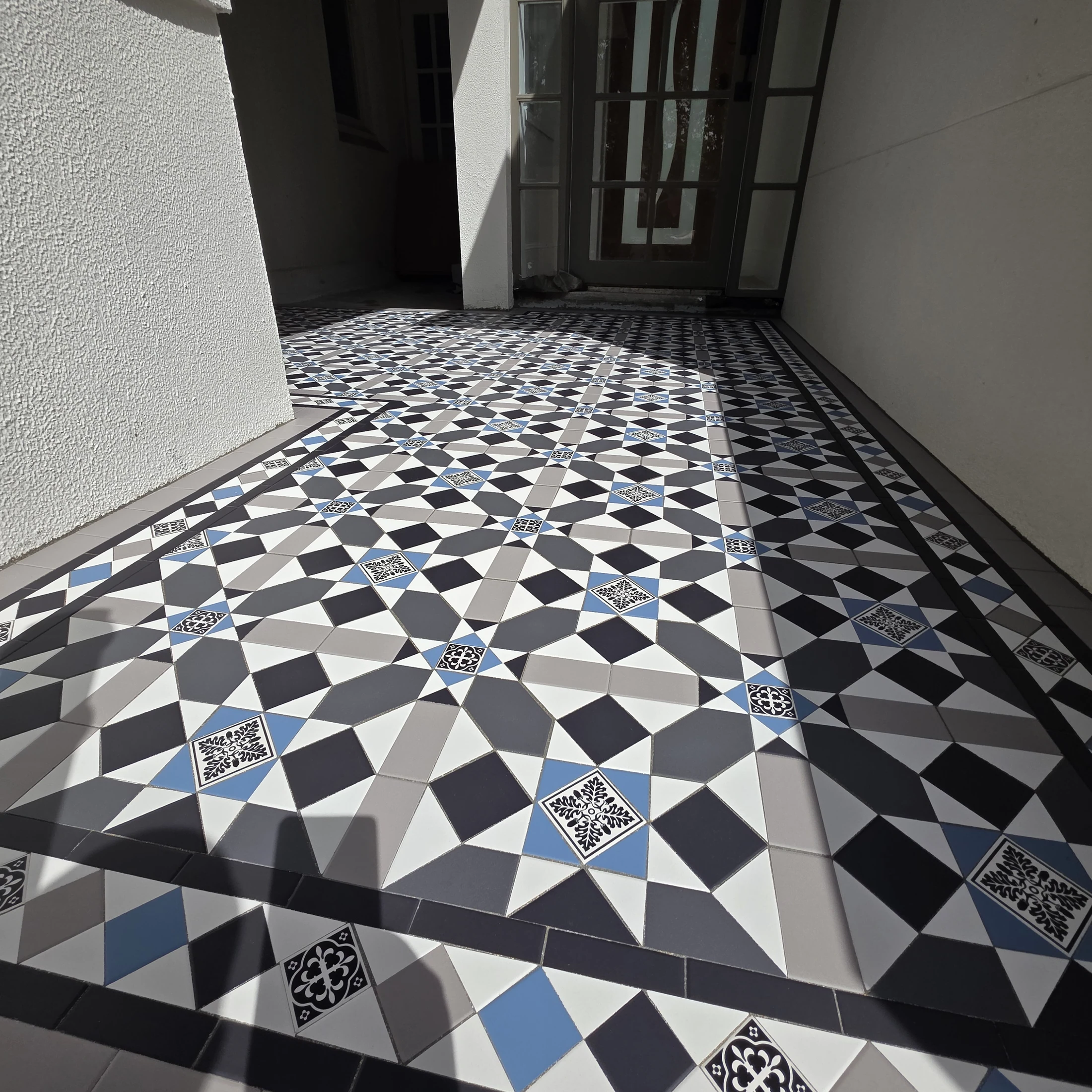
Lindfield's North Shore setting brings together railway-era suburban growth, long-established streets and a leafy local landscape. For a verandah, entrance, pathway or interior floor, tessellated tiles can be planned around the proportions and character of the property rather than treated as a generic pattern. We can help with design consultation, tile supply, installation and restoration for Lindfield projects.
A local setting with layers of history
Lindfield developed through several phases: early timber-getting and farming, the arrival of the railway in 1890, and later suburban growth along the railway and Pacific Highway. Ku-ring-gai Library's local-history collection records the changing locality through images of the station, churches, roads, houses, shops, footpaths and stone work.
That history is useful design context, not a claim that every Lindfield property has the same age or architectural style. A considered tile scheme starts with the individual building, its existing finishes, the approach from the street and the way a new surface will meet thresholds, steps and garden edges.
Check the property before changing its character
Ku-ring-gai Council identifies conservation areas by suburb, including Lindfield and Lindfield and Roseville. Council explains that the valued character of a conservation area can include buildings, architectural style, fences, trees and gardens. A heritage-sensitive tile proposal should therefore consider the whole setting, not only the floor or path being renewed.
A suburb name is not enough to establish a property's listing status. Council directs owners to Schedule 5 and the heritage map in the Ku-ring-gai Local Environmental Plan, and recommends a Section 10.7 Planning Certificate when formal confirmation is needed. Development controls and approval pathways depend on the land, the listing and the proposed work.
Ku-ring-gai Council — Heritage conservation areasDevelopment controls and approvals
Plan the pattern around the property
For Lindfield verandahs and entrances, layout decisions can include the direction of the border, the scale of the field pattern, transitions at doors and the relationship between tiled areas, fences and planting. On a pathway, proportion, edge treatment and changes in level matter as much as the motif. Interior floors call for the same attention to sightlines and how the pattern meets adjoining rooms.
Where original or older tiles remain, assessment should come before replacement. Matching colour, format and pattern is a property-specific exercise, and a new installation should not be presented as a universal substitute for retaining sound existing fabric. We can discuss supply, installation or restoration after considering the condition and intended use of the area.
Ku-ring-gai Council — Heritage conservation areasDevelopment controls and approvals
Lindfield tile services
Use the Lindfield service route to start a conversation about tessellated tile design, supply, installation or restoration. The broader service pages can provide technical detail, while Ku-ring-gai's heritage and planning information remains the place to check a property's statutory status and any applicable approval pathway.
A site-led brief can cover the intended area, existing surfaces, access, pattern direction, edging and the relationship between new work and older fabric. Stone bullnose or edging coordination can also be considered where the design requires a durable transition.
Your Heritage Tiling Questions
Are all Lindfield homes in a heritage conservation area?
No. Ku-ring-gai Council lists conservation areas in and around Lindfield, but a suburb name does not establish the status of an individual property. Check Council's heritage map and Schedule 5 of the Ku-ring-gai Local Environmental Plan; obtain a Section 10.7 Planning Certificate when formal confirmation is required.
What should I consider when planning tessellated tiles for a Lindfield verandah or path?
Begin with the property's existing proportions and approach: consider the field and border scale, pattern direction, thresholds, steps, edges, fences and planting. If older tiles or other original fabric remain, assess their condition before deciding whether to retain, repair or replace them.
Can a heritage-listed Lindfield property be retiled?
A heritage listing does not automatically prohibit change, but proposed work may be assessed through the applicable planning pathway. Ku-ring-gai Council advises checking the LEP, DCP and property mapping, and describes minor heritage works and development applications for relevant proposals. The correct pathway depends on the property and the work.
Does Lindfield's history determine one correct tile pattern?
No. Lindfield's documented history provides useful context, including railway-era growth and a changing mix of houses, streets and public places, but it does not prove that every property shares one period or pattern. Tile selection should respond to the individual building and the area being renewed.
Discuss Your Heritage Tiling Project
Share your location, project details and photographs using our enquiry form, or call 0433 932 711.