
Tessellated tiles in South Geelong
South Geelong sits within the regional City of Greater Geelong and has documented Victorian, Federation and Inter-war residential character. For a verandah, pathway, porch or interior floor, start by understanding the architecture, intended pattern and whether the property sits within a heritage overlay before choosing a layout or restoration approach.
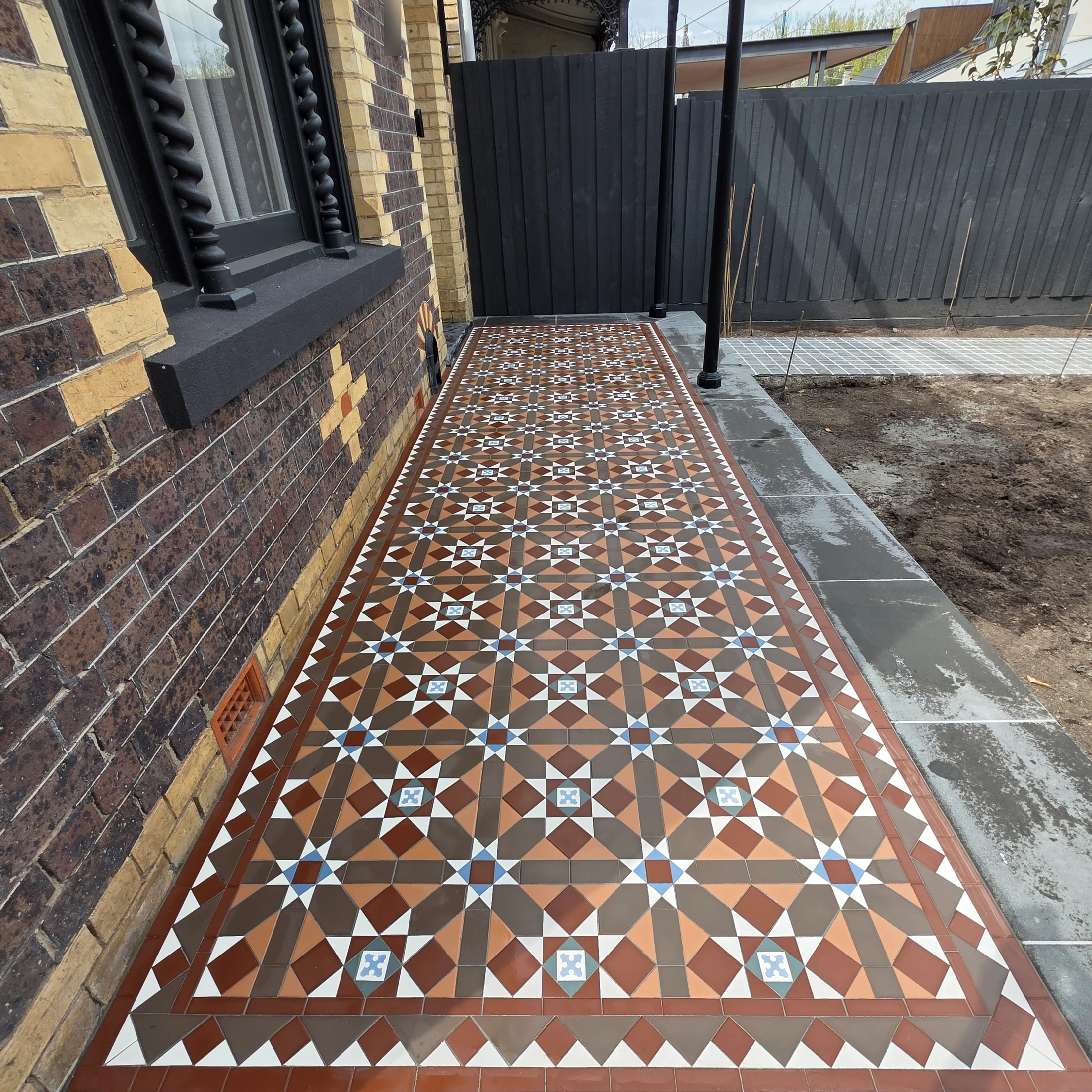
Tiling that responds to South Geelong character
City-led heritage work identifies Victorian, Federation and Inter-war dwellings and South Geelong sub-precincts. That does not mean every property is protected or that one pattern suits the whole suburb. A considered design should respond to the building’s proportions, entry sequence, thresholds and adjoining brickwork, timber or painted surfaces.
Local records illustrate why detail matters. South Geelong examples include pressed red brick, hipped roofs, bullnosed verandahs, timber windows and cast-iron elements, as well as school buildings with later additions and retained Victorian form. These references can inform proportion and transitions without treating one place as a template for every home.
Design, supply and installation for verandahs and paths
For a new verandah or pathway, resolve the layout around available width, street sightlines and the relationship between field tiles, borders and steps. South Geelong’s varied period character makes a site measure and review of adjoining details more useful than a generic pattern choice.
A design consultation can coordinate tessellated tile supply with installation and stone bullnose or edging requirements. The brief should cover levels, thresholds, falls, drainage interfaces and sequencing, with the construction approach selected for the property rather than assumed as universal.
Restoration and property-specific heritage checks
Where older tiles survive, restoration begins by documenting pattern, colour, edge treatment, loose or missing pieces and the condition of the surrounding substrate. Selective repair may be preferable to replacing an intact field; new sections should be resolved against original work rather than promised as an exact historic match without assessment.
Greater Geelong explains that overlays can apply to individual places and precincts, including properties that are not individually significant. Before external changes, check the current planning scheme and seek independent advice from the City or a suitably qualified heritage professional. Tile work does not confer heritage approval or council endorsement.
Your Heritage Tiling Questions
Are all South Geelong homes covered by a heritage overlay?
No. Official material identifies particular places and precincts, and controls depend on the property and current planning scheme. Check address-specific information before external work rather than assuming suburb-wide protection.
What tile design can suit a South Geelong period home?
Start with the home’s proportions and surviving details. Local records include Late Victorian Italianate characteristics such as pressed red brick, hipped roofs, bullnosed verandahs and cast-iron elements, while the wider assessment recognises Federation and Inter-war housing. Select a border and field layout after measuring the entry, verandah or path and reviewing adjoining materials.
Can existing tessellated tiles in South Geelong be restored?
Often, begin with a condition assessment to identify what can be retained, what is loose or missing and how the surrounding surface performs. A repair or partial replacement plan can then be matched to the existing pattern and intended use.
Can tessellated tiles be used on a new South Geelong verandah or path?
They can be considered as part of a site-specific design. Account for width, thresholds, steps, drainage interfaces and stone bullnose or edging alongside the house character and applicable planning controls.
Discuss Your Heritage Tiling Project
Share your location, project details and photographs using our enquiry form, or call 0433 932 711.