
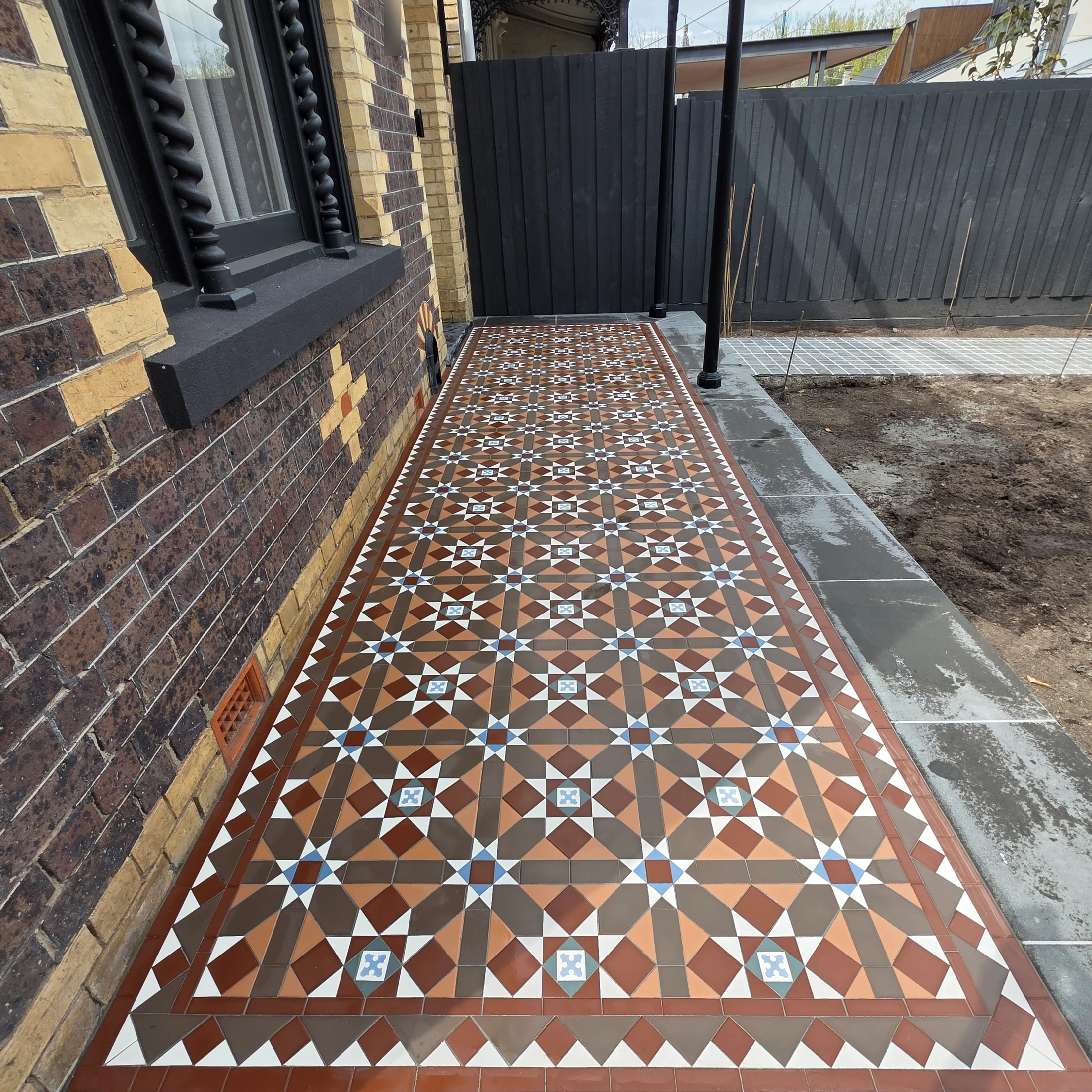
Tessellated tiles in Bundoora
Bundoora's northern Melbourne setting brings together established homes, campus precincts, open space and a small number of formally recognised heritage places. If you are planning a tiled verandah, front path, entrance or interior, the right approach starts with the property's proportions, existing materials and the condition of any tiles that remain. AHTC can help with tessellated tile design consultation, supply, installation and restoration, including stone bullnose or edging coordination where it suits the project.
A Bundoora setting with more than one architectural story
Darebin Council describes Bundoora as a locality north of central Melbourne with RMIT and La Trobe University campuses, Bundoora Park and Bundoora Homestead among its recognised places. That mix means a new tiled surface should respond to the individual property rather than assume one suburb-wide period style.
The Victorian Heritage Register entry for Bundoora Park Homestead records a 1899 two-storey red-brick Queen Anne building with stained glass, pyrography and other fine craftsmanship. That is evidence about a specific registered place, not a claim that every Bundoora house is heritage-listed. For any property with a heritage control or unusual surviving fabric, confirm the relevant requirements before work begins.
Plan the pattern around the property
For an older entrance or verandah, useful design questions include the width of the path, the relationship between border and field tiles, the threshold detail and how the pattern meets steps or edging. A restrained palette can sit comfortably beside brickwork, while a more decorative layout may suit a clearly expressed period feature. The choice should follow the building and its setting, not a generic catalogue look.
Where original tiles survive, an assessment can separate sound areas from loose, cracked, stained or altered sections. Matching is a practical exercise in colour, scale, motif, laying direction and the visual rhythm of the existing surface. New work should be identifiable as new where a seamless reproduction would mislead, while still sitting sympathetically with the retained fabric.
Check the property context before changing a heritage surface
Bundoora crosses the service areas represented by the Darebin and Banyule routes, and the locality includes both everyday residential settings and formally recorded heritage places. A council grouping on a service page is not, by itself, a legal planning determination. If your property is individually listed, affected by a heritage overlay or part of a place with recorded significance, seek property-specific advice from the relevant authority before removing or altering original tiles.
The Banyule Heritage Review also notes that its assessment is not a complete inventory. Treat online heritage material as a useful starting point, then verify the current controls for the actual property and proposed work.
Banyule Heritage ReviewMetropolitan Melbourne regions and local governments — Planning Victoria
Tessellated tile services for Bundoora projects
AHTC's Bundoora service can begin with design consultation and a review of the existing surface, then move into tessellated tile supply, installation or restoration as the project requires. Pathways and verandahs need practical attention to edges, transitions, exposure and the way the finished surface meets adjacent paving or steps.
For projects that call for a crisp perimeter or a durable step finish, stone bullnose or edging coordination can be considered alongside the tile layout. The final recommendation should be based on the property's measured conditions and the intended use rather than a universal construction recipe.
Your Heritage Tiling Questions
Does every Bundoora property have heritage protection?
No. Bundoora includes ordinary residential and institutional settings as well as specific recorded heritage places such as Bundoora Park Homestead. Heritage status is property-specific, so check the current planning and heritage information for the address before removing original tiles or changing a significant surface.
Can existing tessellated tiles in Bundoora be restored rather than replaced?
Often the first step is an assessment of what remains: sound tiles, loose areas, cracks, staining, missing pieces and previous repairs. A restoration plan can then consider cleaning, selective repair, careful matching or a more clearly differentiated new section, depending on the condition and significance of the surface.
What should I consider for a Bundoora verandah or front path?
Consider the property's proportions, the path or verandah width, thresholds, steps, border layout, drainage and how the tile surface meets adjoining materials. These details matter more than choosing a pattern from a suburb label alone.
Which council should I contact about a Bundoora heritage question?
Bundoora is represented across more than one local government area, so the relevant authority depends on the property's location. Use the property's current planning information and confirm with the applicable council or Victorian heritage authority; a service-group route is not proof of the legal authority for every part of the suburb.
Discuss Your Heritage Tiling Project
Share your location, project details and photographs using our enquiry form, or call 0433 932 711.