
Tessellated Tiles in Hurlstone Park
Hurlstone Park's streetscapes include late Federation and Inter-War homes, with some earlier buildings and later changes recorded in the local heritage assessment. For a verandah, pathway, entrance or interior floor, tile choices work best when they respond to the proportions, materials and surviving details of the property rather than treating every house as the same. We can help with design consultation, tessellated tile supply, installation, restoration and stone bullnose or edging coordination.
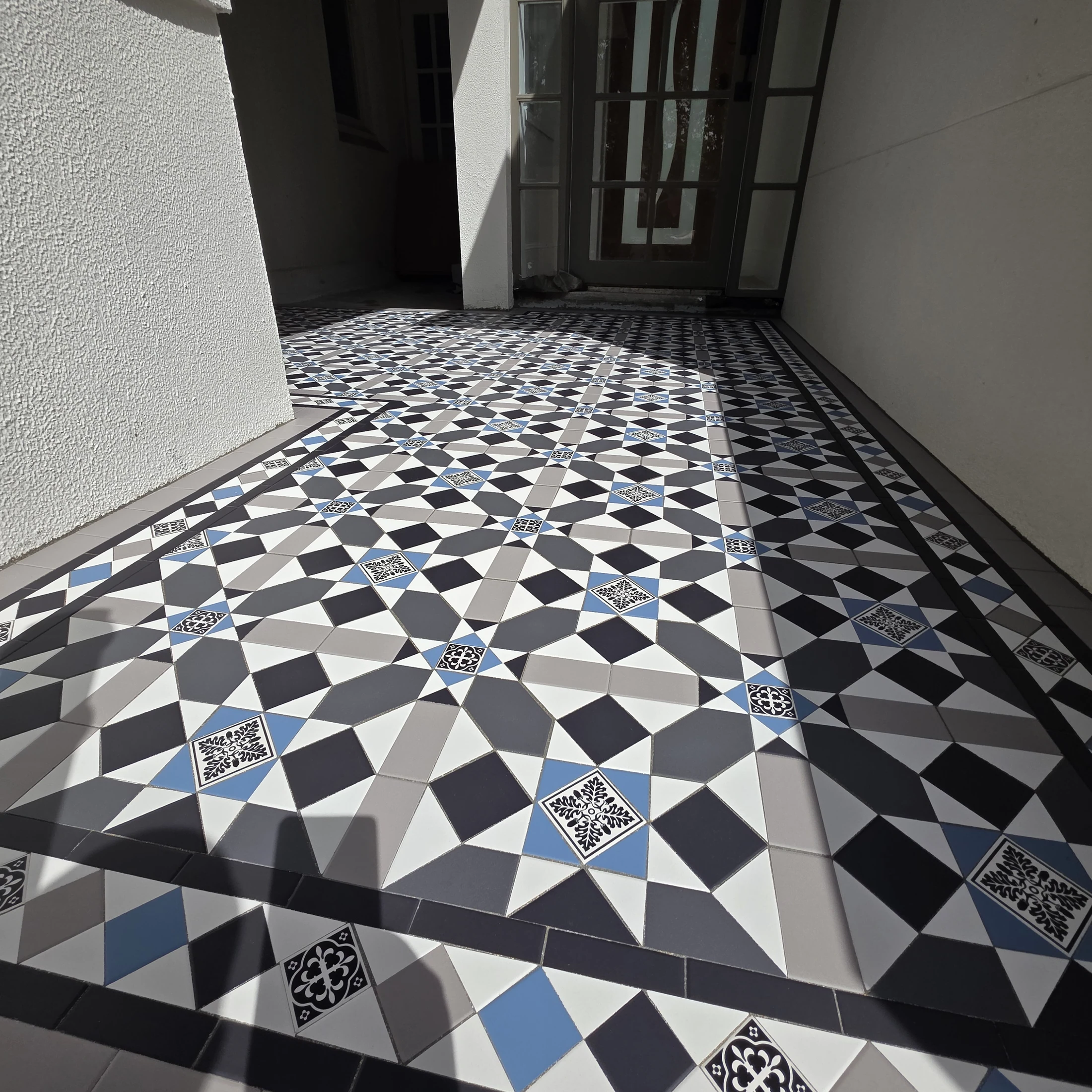
A local character shaped by Federation and Inter-War development
The Hurlstone Park Heritage Assessment Study describes most residential and commercial development as occurring after 1911, when transport access and subdivision accelerated growth. It identifies late Federation and Inter-War development as the suburb's principal character periods, alongside a smaller late Victorian layer and later redevelopment.
That history can inform a tile scheme without turning a period label into a fixed design rule. Consider the home's front elevation, entry sequence, verandah scale, garden relationship and any surviving floor or border before choosing a repeat, colour balance or edge treatment. A quieter arrangement may sit comfortably beside a restrained Federation frontage, while an existing geometric floor may call for careful matching and selective repair rather than replacement.
Designing for verandahs, paths and entrances
For a new verandah or pathway, start with the width, thresholds, steps, sightlines and junctions with the garden or driveway. A border can clarify an edge, but it should be set out around real dimensions and transitions rather than copied from a generic pattern. Stone bullnose or edging coordination can help define steps and exposed edges where the site calls for it.
Where original tiles remain, document the layout, colour relationships, perimeter and condition before selecting new work. Restoration may involve retaining sound areas, matching the visual rhythm of missing sections and making new junctions legible. The appropriate approach depends on the property and the condition found on site.
Check the property context before work begins
Canterbury-Bankstown Council identifies six Heritage Conservation Areas in Hurlstone Park and explains that heritage significance may relate to individual places or to a collective streetscape. That does not mean every Hurlstone Park property has the same heritage status. Check the current Canterbury-Bankstown LEP and DCP, and seek council or heritage advice for the specific property before finalising work that could affect significant fabric.
Council also explains that heritage listing or inclusion in a conservation area does not automatically prevent change, but listed-property work commonly involves development-consent requirements. The historic Hurlstone Park planning proposal record on the NSW Planning Portal is marked cancelled, so older proposal material should not be treated as a current approval or blanket rule.
Heritage | City of Canterbury BankstownPlanning proposal to include new local heritage items and heritage conservation areas in Hurlstone Park | NSW Planning Portal
A considered tile plan for your Hurlstone Park property
A useful first step is to share photographs, dimensions and the way the area is used. We can then discuss whether the brief is new supply and installation, restoration of an existing floor, or a coordinated verandah, pathway and edging design. The design should be reviewed against the property's own fabric and the current planning context rather than assumed from the suburb name alone.
Your Heritage Tiling Questions
Does every Hurlstone Park home have heritage protection?
No. Canterbury-Bankstown Council distinguishes individual heritage items from Heritage Conservation Areas, where the collective streetscape or broader built environment has significance. Check the current LEP, DCP and council advice for the particular property.
What architectural context can guide a Hurlstone Park tile design?
The local heritage assessment identifies late Federation and Inter-War development as the suburb's principal character periods, alongside some late Victorian buildings and later changes. Use those findings as context, then respond to the actual home's scale, surviving details and setting.
Can existing tessellated tiles be restored rather than replaced?
Often the right decision depends on the condition, extent and significance of what remains. Begin with an assessment of the existing layout and fabric so sound areas, missing sections and new junctions can be considered together.
Should I check with council before tiling a heritage property?
Yes. Canterbury-Bankstown Council advises owners to check the applicable controls and seek heritage or planning advice. It notes that listed-property work normally requires development consent, while some minor works may be treated differently after written council advice; requirements are property- and work-specific.
Discuss Your Heritage Tiling Project
Share your location, project details and photographs using our enquiry form, or call 0433 932 711.