
Tessellated tiles in Rosemeadow
Rosemeadow is a planned residential suburb in Campbelltown's south-western Sydney setting. For a home here, a successful tessellated-tile scheme starts with the property rather than a period label: consider the proportions of the entry, verandah or pathway, the relationship with planting and shade, and how existing surfaces meet doors, steps and garden edges. AHTC can help with design consultation, tessellated tile supply, installation, restoration and stone bullnose or edging coordination.
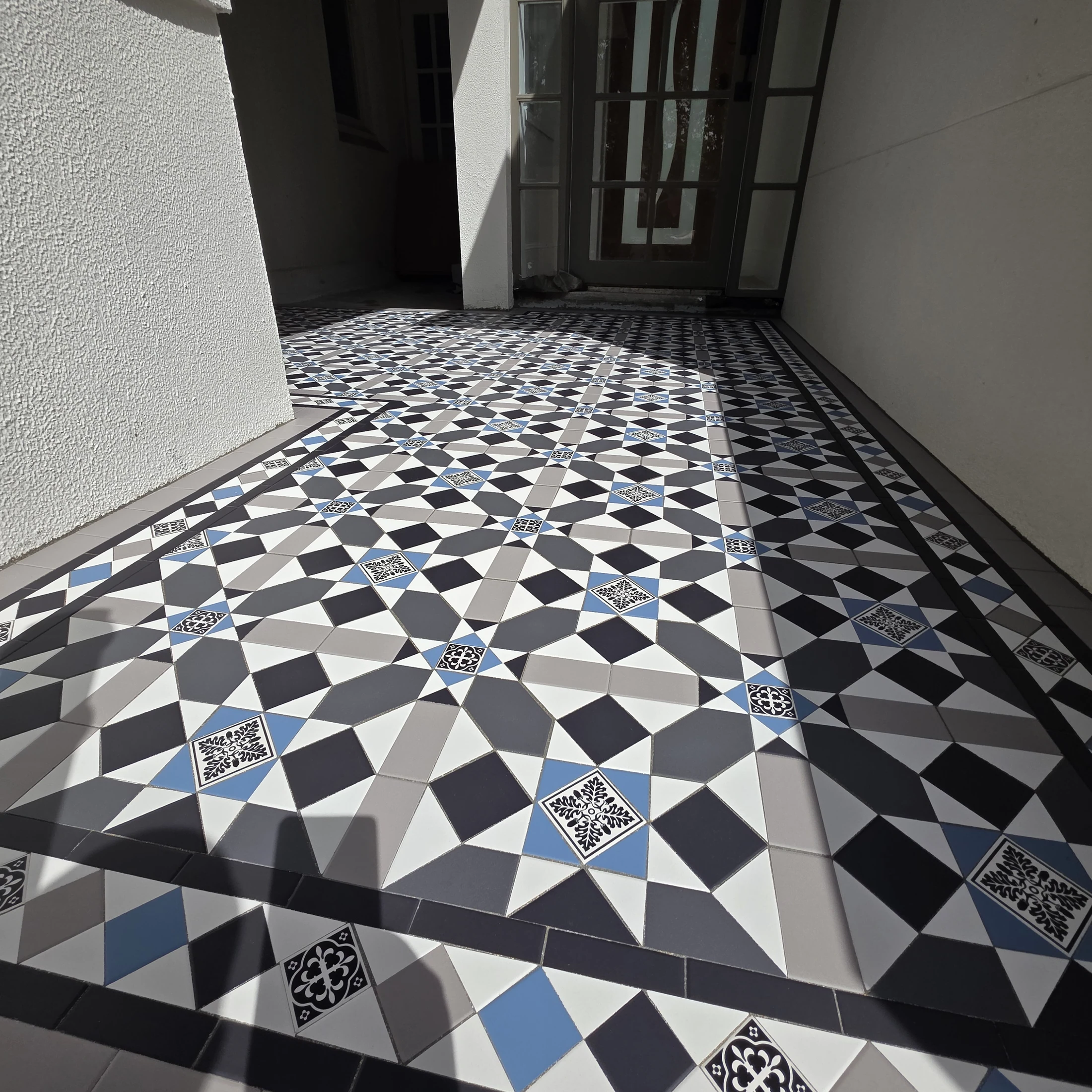
A Rosemeadow setting for considered tile design
Campbelltown City Council records Rosemeadow as a suburb within the Campbelltown local government area in Sydney's south-west. The modern suburb was planned in the mid-1970s and developed through the 1980s, so a local tile brief should respond to the individual dwelling and its landscape rather than assume a single historic house style. [Council's Rosemeadow history] [1] [Council community profile] [2]
Rosemeadow's public-domain story also includes a documented focus on tree canopy, cooling and integrated stormwater management. For an outdoor tiled area, that makes the junctions between paving, planting, downpipes, thresholds and drainage worth resolving early. These are design considerations, not a claim that every property has the same site conditions. [NSW Planning's Rosemeadow project] [3]
Planning a verandah, entry or pathway
On a Rosemeadow property, begin by measuring the space and identifying the fixed points: steps, door swings, piers, garden borders and drainage paths. A repeating tessellated layout can then be developed around the available width, with borders and turning points placed where they support the architecture instead of leaving narrow cuts at the edges.
For paths and verandahs, discuss exposure, falls, surface transitions and how the new work will meet adjoining finishes. Tile selection should balance pattern, scale and maintenance with the way the area is used. Design consultation can also help decide whether stone bullnose or another coordinated edge treatment is appropriate.
Restoring existing tiles or introducing new work
If an existing Rosemeadow entry or verandah has surviving tessellated tiles, document the pattern, colour relationships, edge details and areas of loss before any removal. A condition-led assessment can separate sound original fabric from later repairs and guide a careful restoration or a clearly distinguished new section.
Where a property needs a new tiled area, the design can still acknowledge the home's proportions and established garden setting without pretending the suburb has a uniform heritage character. The right approach depends on what is present on the property, how the area is used and the performance requirements of the site.
Campbelltown Local Government Area Heritage Review — Campbelltown City Council
Your Heritage Tiling Questions
Are all Rosemeadow homes heritage properties?
No. Rosemeadow's documented development is largely associated with the modern suburb planned from the mid-1970s and built through the 1980s. A property's heritage status, if relevant, needs to be checked for that specific property and planning context rather than inferred from its suburb name.
Can tessellated tiles work on a newer Rosemeadow home?
Yes. Tessellated tiles can be designed around a newer home's entry, porch, verandah or pathway. The useful starting points are proportion, pattern scale, adjoining materials, drainage and the way the space is used, not an assumed architectural period.
What should I consider for an outdoor tiled area in Rosemeadow?
Discuss exposure, shade, falls, thresholds, garden edges and stormwater routes before finalising the layout. Rosemeadow has been the subject of public-domain work addressing canopy and integrated water management, but each property's conditions still need to be assessed individually.
Can existing tiles be restored rather than replaced?
Often the first step is a condition assessment to understand which tiles, borders and substrate areas remain sound. A restoration or selective replacement approach can then be considered alongside the desired use and appearance of the space.
Discuss Your Heritage Tiling Project
Share your location, project details and photographs using our enquiry form, or call 0433 932 711.