
Tessellated Tiles in Eastwood, SA
Eastwood sits in Adelaide's south east within the City of Burnside. Its setting combines a busy Glen Osmond Road community precinct with the broader residential and period-architecture character documented across Burnside. For a verandah, entry, pathway or interior floor, tessellated tile work should respond to the property's proportions, existing materials and the condition of any surviving surface rather than impose a period look by assumption.
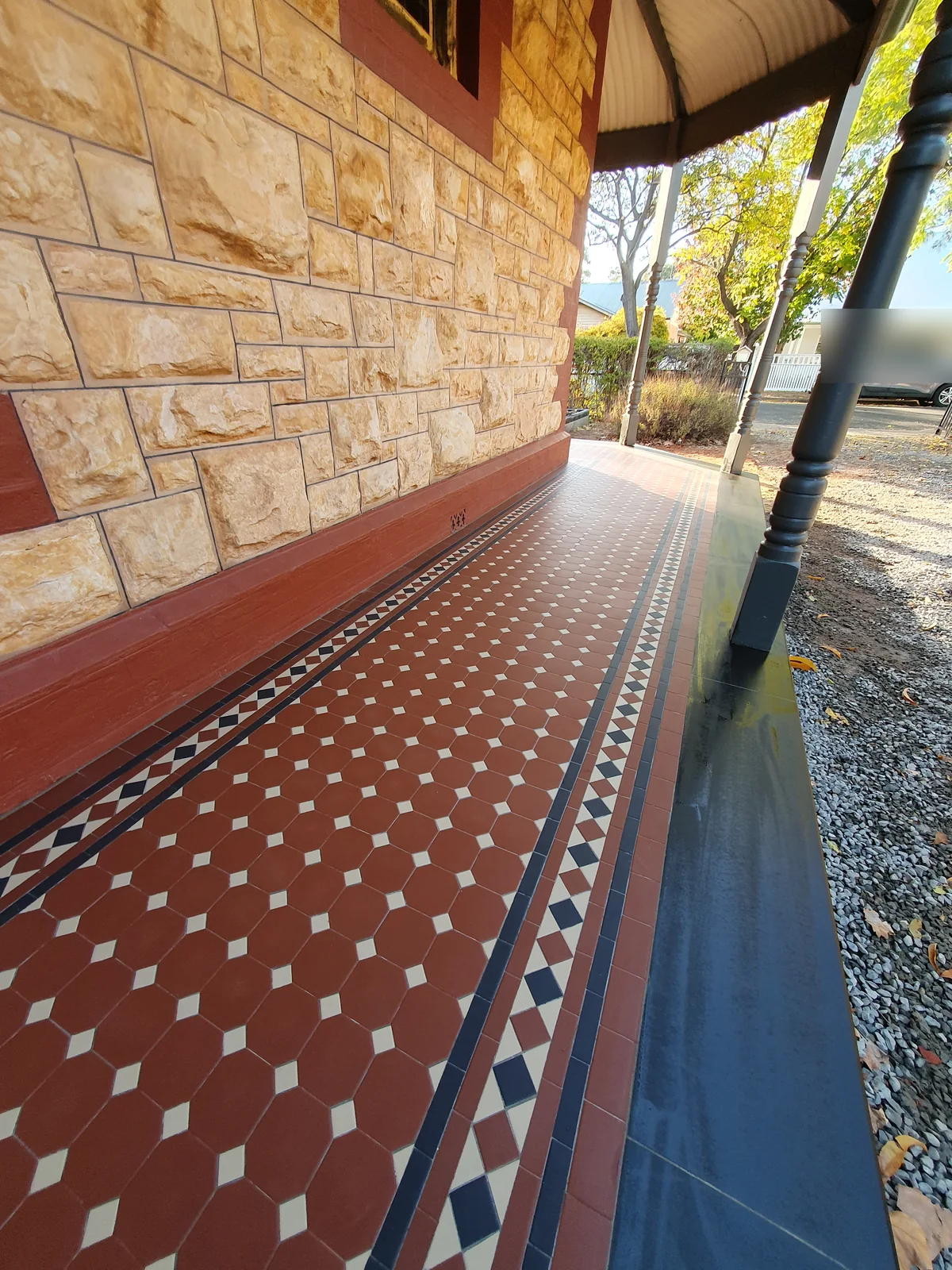
Designing for Eastwood's residential setting
Burnside's heritage survey records a varied residential building stock shaped over many decades, with differing architectural styles and examples of substantial stone and brick construction. In Eastwood, that makes the relationship between a tile layout and the building important: border scale, geometric rhythm, stair or threshold transitions and the visual weight of adjacent masonry all affect the result.
The Eastwood precinct on Glen Osmond Road has a more active mainstreet character, while nearby residential work may call for quieter proportions. A design consultation can compare a new tessellated layout with the facade, verandah line, garden paths and existing paving so the pattern feels considered at the property rather than copied from a generic catalogue.
Where an older surface remains, document its pattern, dimensions, colour balance and condition before deciding whether to retain, repair, carefully supplement or replace it. New work should be clearly planned around the existing fabric and site conditions, with transitions and drainage considered at the design stage.
Burnside Heritage Survey (South Australia), Part One General Report
Heritage-sensitive tile work in Eastwood
The South Australian Heritage Places Database records a local heritage place in Eastwood with an 1884 two-storey building, rendered Italianate facade and stone walls. That is evidence of a specific listed place, not a designation covering every home in the suburb.
If a property is listed or lies within a relevant planning or character area, confirm the applicable requirements with the appropriate authority before changing significant external fabric. A property-led assessment can help separate original or early tilework from later additions and identify where a sympathetic repair or carefully matched new section is more appropriate than wholesale removal.
For properties without a heritage listing, the same disciplined approach can still improve the outcome: record what is present, test proposed proportions against the architecture and coordinate tile supply, installation and stone bullnose or edging details as one design decision.
Heritage surveys | South Australian GovernmentBurnside Heritage Survey (South Australia), Part One General Report
Planning a tessellated tile project
A useful first step is to identify whether the project is a new verandah or pathway, a tiled entry or floor, or restoration of surviving tessellated work. The scope affects pattern development, tile matching, edge treatment, access and sequencing.
AHTC can discuss design consultation, tessellated tile supply, installation, restoration and coordination of stone bullnose or edging details. Share photographs and dimensions of the area, along with any known heritage or planning information, so the design conversation starts with the actual property and its existing fabric.
Your Heritage Tiling Questions
Is every Eastwood home heritage listed?
No. The South Australian Heritage Places Database records individual places, including a local heritage place in Eastwood, but that does not make every property in the suburb heritage listed. Check the status of the specific property and its planning context before altering significant external fabric.
What should be considered when choosing tessellated tiles for an Eastwood verandah?
Consider the building's facade, verandah proportions, adjacent stone or brickwork, thresholds, pathway connections and the scale of the pattern. A design that responds to the property is usually more convincing than a period motif selected without reference to the existing architecture.
Can existing tessellated tiles in Eastwood be restored?
Often the right approach depends on what survives and its condition. Photograph and assess the pattern, tile sizes, colours, edges and areas of loss before choosing selective repair, careful supplementation or replacement. Heritage status and the significance of the existing fabric should also be checked where relevant.
Does the Glen Osmond Road precinct define all of Eastwood's architecture?
No. The City of Burnside describes Glen Osmond Road as a community mainstreet precinct with shops and community uses. Residential properties elsewhere in Eastwood should be assessed on their own architectural setting and existing materials.
Discuss Your Heritage Tiling Project
Share your location, project details and photographs using our enquiry form, or call 0433 932 711.