
Tessellated Tiles in Mascot, NSW
Mascot's built setting brings together established residential streets, planned neighbourhood history and the practical influence of Sydney Airport and surrounding industry. For a verandah, pathway, entry or interior floor, a considered tessellated-tile scheme should respond to the property's proportions, existing fabric and the way the site is used. AHTC can help with design consultation, tessellated tile supply, installation, restoration and stone bullnose or edging coordination.
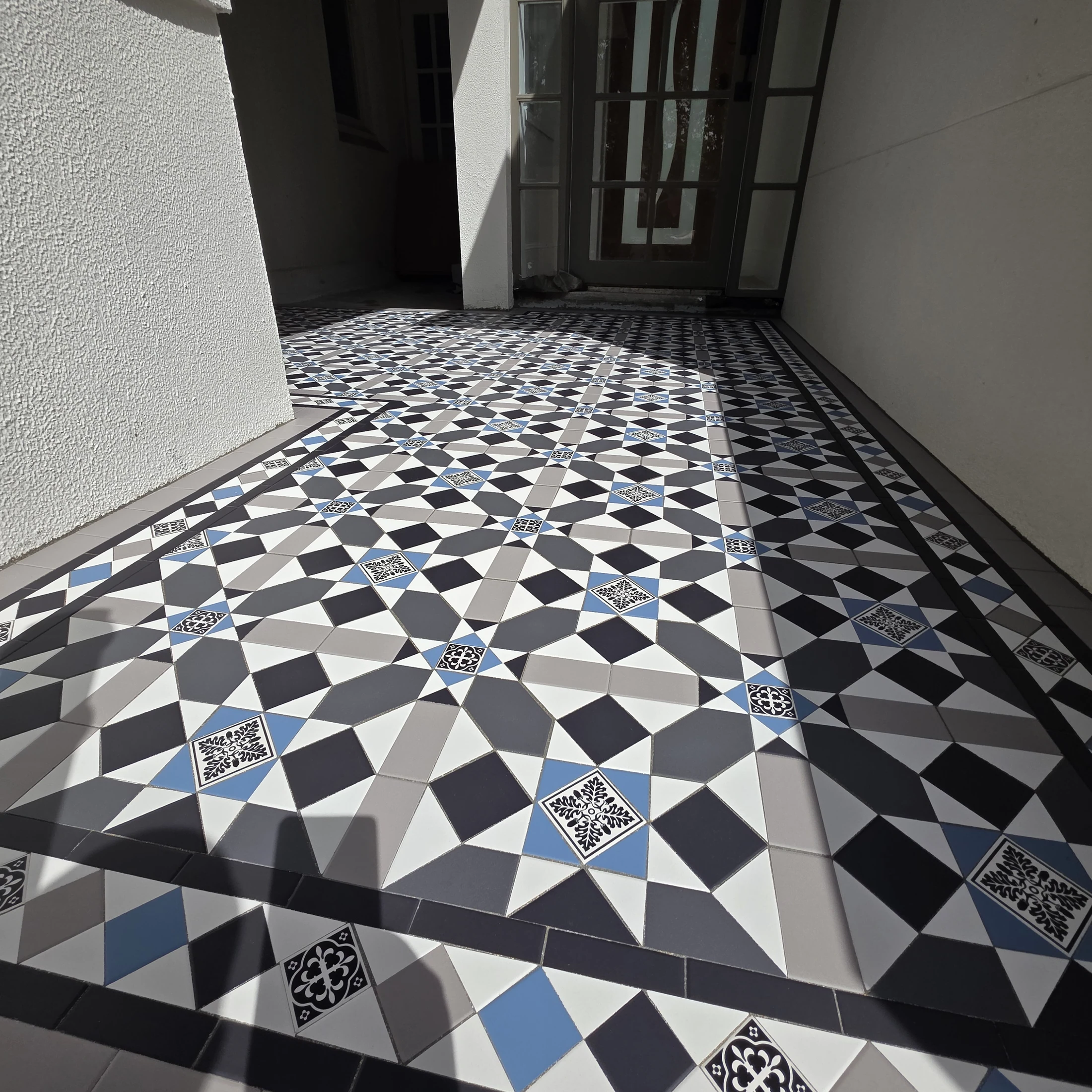
A Mascot context shaped by planned neighbourhoods and working infrastructure
Bayside's Mascot history material records Daceyville as an eastern extension of Mascot planned with parks, gardens, public buildings, broad avenues and secondary roads. That documented planning history is useful design context: the scale and rhythm of an older frontage or pathway can matter as much as the tile pattern itself.
The wider Botany-area record also describes Mascot's airport history and the long-standing adjacency of homes and industry. A practical tile proposal therefore needs to consider more than period references. Access, exposure, transitions and the relationship between indoor and outdoor areas should be reviewed at the property rather than assumed from the suburb name.
Mascot 1888-1938 - Fifty Years of Progress | Bayside Council
Property-led design for verandahs, paths and floors
For an older Mascot property, begin by recording what survives: thresholds, stair geometry, skirtings, adjacent masonry, drainage falls and any original tile fragments. A new layout can then be proportioned to the building instead of imposing a generic pattern. On a verandah or front path, borders and transitions should follow the available width and the way doors, steps and gates are approached.
Where the work meets newer additions or more utilitarian parts of the property, a restrained transition may be more appropriate than extending a historic-looking pattern everywhere. Design consultation can compare colour, scale, border treatment and edging coordination before supply and installation are scheduled.
Mascot 1888-1938 - Fifty Years of Progress | Bayside CouncilPlanning Proposal to Create Heritage Conservation Areas | Bayside Council
Check heritage controls before changing established fabric
Bayside provides resources for identifying heritage-listed properties and Heritage Conservation Areas and for understanding development approval requirements. The council's heritage-conservation-area consultation also explains that controls can address built form, scale, materials and siting. Those controls are property- and area-specific, so a tile proposal should not assume that every Mascot home is protected or that approval is automatically required.
The same consultation records that a proposed Aloha and Forster Streets, Mascot conservation area was removed from the final proposal. That is a reason to check the current listing and planning position for the particular property, not a reason to treat the whole suburb as unregulated. AHTC's role is to help develop a suitable tiling approach; it does not provide council heritage approval.
Heritage ConservationPlanning Proposal to Create Heritage Conservation Areas | Bayside Council
Craftsmanship that respects the existing setting
Restoration begins with an assessment of the existing tiled surface and its relationship to surrounding finishes. Matching should be approached carefully where original tiles remain, while new work should be designed around the property's proportions and practical use. For pathways and verandahs, the detail at edges, steps and thresholds deserves the same attention as the central field pattern.
For a new installation, the useful sequence is to clarify the design, review the site and access conditions, coordinate the tile supply, and then confirm installation details with the property context in view. The final specification should be based on the actual site rather than a universal recipe.
Heritage ConservationMascot 1888-1938 - Fifty Years of Progress | Bayside Council
Your Heritage Tiling Questions
Does every Mascot property have heritage protection?
No. Heritage status is property- and area-specific. Bayside provides resources for checking listed properties and Heritage Conservation Areas, and the current planning controls should be checked for the particular property before work begins.
Was the proposed Aloha and Forster Streets conservation area created?
Bayside's consultation page states that the proposed Aloha and Forster Streets, Mascot area was removed from the final proposal. That does not determine the status of an individual property, so current records should still be checked for the address.
What should be considered when planning a tiled verandah or pathway in Mascot?
Review the property's proportions, surviving fabric, thresholds, steps, access, drainage and the relationship between the tiled area and newer work. Mascot's documented planned-neighbourhood history makes scale, rhythm and edge detailing useful design considerations, but the final layout should be site-led.
Can existing Mascot tiles be restored rather than replaced?
An assessment is needed first. Where original or older tiles survive, restoration and selective repair may be considered alongside matching and practical performance. The appropriate approach depends on the condition of the surface and the surrounding construction.
Discuss Your Heritage Tiling Project
Share your location, project details and photographs using our enquiry form, or call 0433 932 711.